

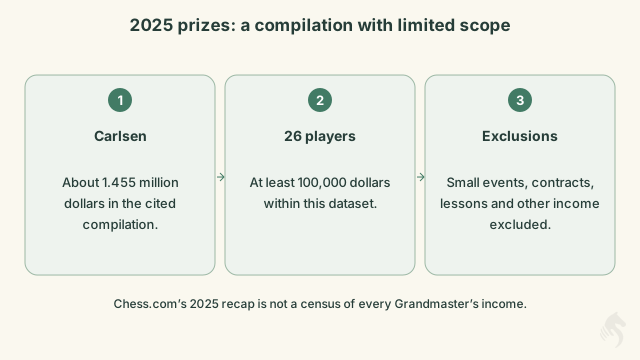
In 2025, the tournament prizes recorded by Chess.com for Magnus Carlsen exceeded $1.45 million. That is a substantial amount. It still does not tell us what a Grandmaster can expect to earn, how much Carlsen keeps after expenses, or his net worth.
Chess economics becomes clearer when we separate four things: an event's prize fund, a player's prizes, net income and personal wealth. Mixing them produces dramatic but misleading comparisons.
This article uses 2025 data as a dated snapshot. It explains what they show, what remains unknown and the practical questions to ask before considering professional activity. For participation and representation, see also Chess and women.
The figures: what we know and what we do not
What a professional player earns
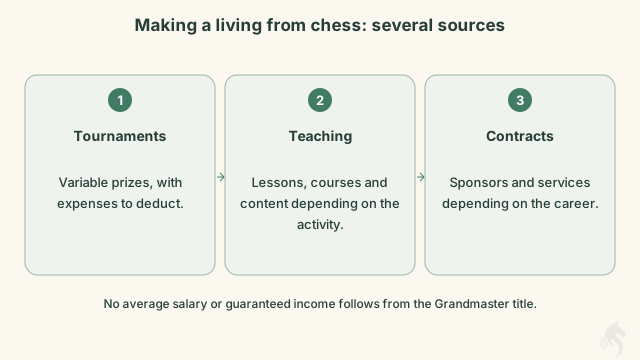
The Grandmaster title recognizes sporting achievement; it does not entitle someone to a universal salary. Players may receive revenue from several activities:
- Competition: prizes, possible appearance fees and team contracts, depending on events and agreements.
- Teaching: individual or group lessons, training camps, work for a club or federation.
- Content: books, videos, digital courses, commentary or livestreaming.
- Partnerships and events: sponsorships, simultaneous exhibitions and paid appearances.
These possibilities do not establish that most players live from any particular source. A coach's advertised rate is a price for a service, not net hourly income: preparation, finding students, cancellations and expenses must be considered.
The sources used here are not a representative survey of all Grandmasters' earnings. They therefore cannot establish a €20,000-40,000 salary for a rating band, or “typical” tournament income of $40,000 outside the Top 50.
2025 prizes: a window onto major competitions
Chess.com's original recap, published after the year ended, mainly tracks major individual international events, generally with a first prize of at least $10,000. Here are three entries:
| Rank in this 2025 record | Player | Recorded prizes in 2025 |
|---|---|---|
| 1 | Magnus Carlsen | $1,455,276 |
| 5 | Alireza Firouzja | $455,047 |
| 10 | Javokhir Sindarov | $349,955 |
Within this scope, 26 players reached $100,000. Carlsen alone exceeded $1 million. The record excludes, among other things, small tournaments, national championships, team events and revenue other than prizes.
We cannot divide these 26 players by a worldwide Grandmaster count to conclude that “98% earn less than $100,000”. The numerator and denominator do not cover the same population or all competitive earnings. The source describes concentration at the top of the events recorded; it is not a worldwide tax return.
Expenses require another precaution. Gross prizes are not money available for living: travel, accommodation, entry fees, training and taxes may apply. Which costs are covered varies by contract. Comparing two careers properly would require knowing these details.
Comparing competitions without mixing categories
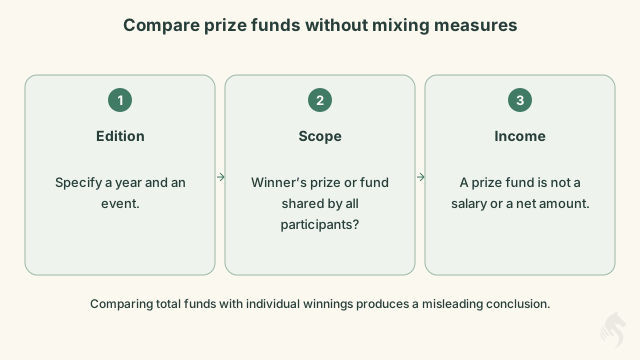
A first prize is not a total fund. These figures were announced for 2023 editions, with their currency and scope:
| 2023 event | Stated total fund | What the figure covers |
|---|---|---|
| World Chess Championship match | €2,000,000 | Fund shared by two players under FIDE regulations |
| Nitto ATP Finals | $15,000,000 | Announced fund for the tennis event |
| WSOP Main Event | $93,399,900 | Main Event poker prize fund, according to official results |
FIDE regulations provide a 55%-45% split between winner and runner-up if tiebreaks decide the title: Ding's share of that fund is therefore €1.1 million, not dollars. The WSOP Main Event paid $12.1 million to its winner; this must not be presented as the whole fund. The ATP also distinguishes the total allocation from the champion's earnings depending on results.
These competitions differ in participant counts, entry fees and distribution. Currencies have not been converted. The table provides dated scales of magnitude; it does not establish which profession pays an average participant most.
Why popularity alone cannot guarantee income
Different organizers and contracts
A FIDE championship, a private tournament, a team league and an online series do not constitute a single employer. Access, prizes and any contracts must be examined separately.
This organization raises economic questions: who finances an event, who bears cancellation risk, which expenses are covered and what commitment extends beyond that edition? A major tournament's publicity alone cannot establish career stability.
This does not mean that revenue sharing or broadcasting rights never exist. It means reading the applicable agreements rather than imagining one salary shared across the circuit.
An audience is not revenue available to every player
Attention may be monetized through tickets, advertising, subscriptions or sponsors. But a free view, a registered account and a paid subscription are three different units. A large audience alone does not reveal the share reaching a player.
Production choices matter too: accessible commentary, pace, schedules and language can change the audience's experience. Revenue and costs still require measurement. Claiming that television “cannot sell chess”, or that digital distribution solves everything, would be too simple.
History cannot replace current accounts
The political dimension of chess, particularly visible in the 1972 Fischer-Spassky match, reminds us that sports funding is not only about ticket sales. Prestige, institutions and patronage may play a role.
That does not establish that every professional of one era had a salary, or that an entire later generation left chess for finance. Understanding a current career requires identifying actual supporters, the duration of support and its conditions.
The digital revolution: opportunities and unknowns
Platforms: visible activity, private profitability
A platform can sell subscriptions, courses or advertising and organize competitions. Chess.com's announcement of its 2022 acquisition of Play Magnus Group documents a transaction and the brands involved. It is not an income statement for Chess.com.
Multiplying an account count by a Premium price and an assumed 5% conversion rate does not establish revenue. Missing information includes actual paying subscribers, prices by country and offer, discounts, costs and the relevant periods. We establish neither its margin nor its current valuation here.
“Who captures the value?” remains a valid question, but answering it requires contracts and accounts. A teacher, author, player and platform may receive different cash flows from the same activity.
Streaming: a different professional activity
Hikaru Nakamura illustrates the visibility a player can acquire as a content creator. That does not reveal his net subscription income, contracts or production costs.
Producing a show involves distinct work: scheduling, presenting, editing, moderation and commercial relationships. A high rating may attract attention; it does not replace those skills. Conversely, an audience does not predict the income of every player with the same Elo.
The model can diversify an activity without automatically solving every professional's situation. Chess-player psychology also provides a way to consider motivation when playing must be combined with satisfying an audience.
Online events: specify the format and agreement
A rapid competition broadcast live can be designed around shorter schedules and an online audience. Comparing it with a classical tournament involves more than prestige: prizes, access, rights and constraints also matter.
A format attracting a sponsor does not mean all players will earn more or that it will replace other formats. A series announced for one season is not a permanent commitment.
Magnus Carlsen: tournament prizes, business and wealth
The same Chess.com recap places Carlsen's recorded career prizes at about $12.23 million through December 31, 2025, without inflation adjustment. Presenting $2.4 million as his lifetime total is therefore wrong within that scope. Even the corrected total is not an estimate of his net worth.
Play Magnus Group was a business with multiple shareholders and activities. The December 16, 2022 offer-completion announcement states a price of NOK 13 per share. The group's acquisition price cannot be attributed in full to the individual whose name it carries.
To calculate what Carlsen received and retained, we would need relevant shareholdings, the arrangements of the structures involved and taxation. Calculating wealth would also require other assets and liabilities. We do not possess that private balance sheet.
Chessable was among the brands mentioned in the transaction. Selling a course may allow an author to monetize expertise, but income depends on contract terms and sales; it is neither automatically substantial nor entirely “passive”.
Carlsen's case mainly shows why sporting activity, commercial rights and equity ownership must be separated. It cannot establish the net worth of Alireza Firouzja, Nakamura or another player from a partial prize database.
What is changing: actual events, not guaranteed earnings
Saudi Arabia and the 2025 Esports World Cup
A verifiable example is the announcement of chess at the 2025 Esports World Cup in Riyadh, with an announced $1.5 million fund. It was not a supposed “2023 FIDE Grand Prix”.
Such partnerships raise legitimate questions about financial dependence, governance and image. Examining them requires naming the funder, event and contract; a bigger prize fund alone does not establish a partner's precise political motive or an improvement across the whole circuit.
India and its champions' visibility
Gukesh won the world title in 2024. He was not the first Indian champion: Viswanathan Anand preceded him. A new generation's visibility may interest organizers, students and commercial partners.
Moving from a title to a market estimate, however, requires measuring registrations, contracts or revenue. A compelling sporting story is not, by itself, a quantified income-growth forecast.
Esports as an organizational comparison
Teams, broadcast events and platform partnerships offer models to study. They also raise familiar questions: funding duration, image rights, schedules, exclusivity and revenue sharing.
Rather than presenting one model as already viable for everyone, ask what is actually guaranteed to a player and what depends on future results or audience size.
Summary: useful indicators
| Question | Useful information | What it cannot replace |
|---|---|---|
| How much does a tournament pay? | Rules and prize distribution | A player's annual income |
| How much does a career earn? | Revenue, costs and duration | An Elo rating |
| How much is a business worth? | Terms of a dated transaction | A shareholder's personal wealth |
| Is content creation viable? | Contract, sales, costs and working time | Raw follower counts |
| Is a platform profitable? | Accounts and accounting scope | An acquisition price |






Comments