
A chessboard offers a useful setting for a philosophical question: what does it mean to understand a rule, choose or justify a decision? Pieces and moves make distinctions visible that can become blurred when discussing thought in general. Yet a persuasive illustration is not automatically a historical argument or a proof.
Wittgenstein explicitly uses chess in Philosophical Investigations. For Hegel, Sartre and Nagel, the connections below are interpretations proposed in this article, based on identified passages. They do not mean these authors formulated the chess examples used here as applications of their ideas. Keeping that distinction preserves the analogy’s interest without inventing a quotation or doctrine of the game.
Wittgenstein: chess as a laboratory for language
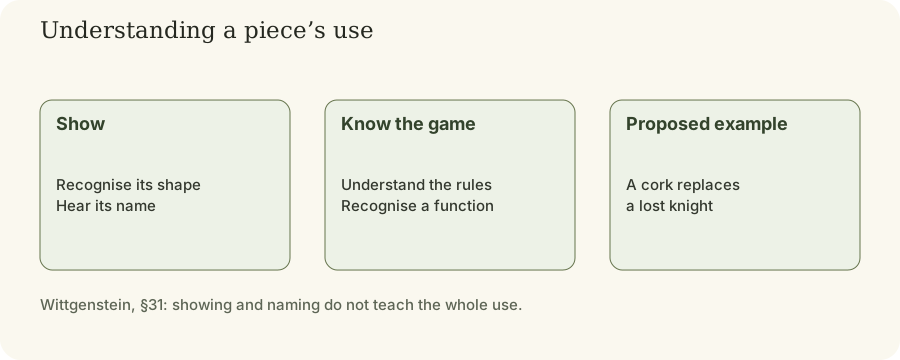
In §31 of Philosophical Investigations (1953), Wittgenstein considers what happens when someone points out the king and names it. That gesture alone does not explain the piece’s use. It becomes informative if the learner already has some command of the game or the practices in which the explanation belongs. The example concerns the conditions of explanation, not a mysterious property hidden in the wood.
Imagine an informal game in which a bottle cap replaces a missing knight. If both players recognise its role, the substitution can work. This is our illustration of the distinction between a material object and its acknowledged use; the cap is not presented as an anecdote reported by Wittgenstein. The same shape could serve another function in another game, and simply pointing to it would not teach all those practices.
Section 43 associates meaning with use for a large class of cases, without making this a definition covering every case. That qualification matters. It would overstate the book to claim that words can never name things or that every search for a definition is mistaken. Rather, the discussion invites us to examine how an expression works in concrete situations instead of assuming that a name immediately reveals its meaning.
Sections 66 onwards also examine what we call games: their resemblances need not reduce to one feature shared identically by all of them. At the board, this becomes an exercise: explaining how a knight moves, pointing out a piece and learning to play are connected but different activities. That precision is more useful for discussing language than a slogan mechanically opposing use and essence.
Hegel and the dialectic of a game
In the Logic of the Encyclopaedia, §§79–81, Hegel distinguishes abstract, dialectical and speculative moments. He describes, among other things, how finite determinations encounter their limits. These passages do not present a chess cycle in which every move is a thesis followed by an antithesis and a synthesis. Reducing his method to that recipe would obscure the philosophical problem he examines.
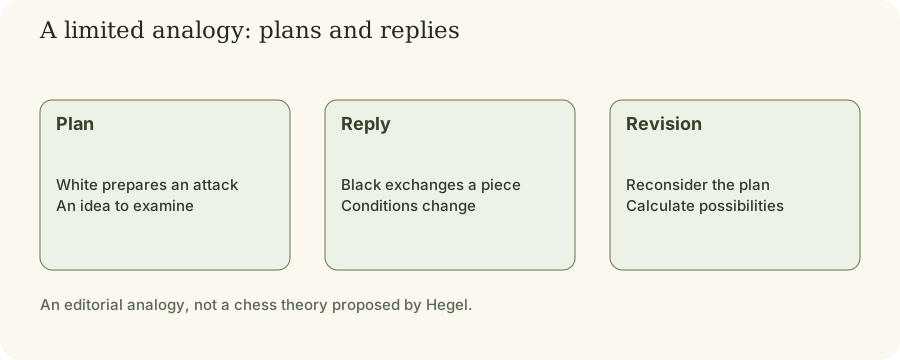
Nevertheless, we can propose a limited analogy. White prepares an attack; Black exchanges an essential piece; the resulting position forces White to revise the plan. The point is not to attach three labels to three board diagrams, but to notice that a decision makes sense within a relationship and that an opponent’s response can alter the conditions of the original plan.
The limitation is immediate: Black’s reply is not necessarily a logical contradiction, and a new position is not automatically a philosophical overcoming. A waiting move, a forced exchange or a tactical mistake does not fit neatly into the same story. The analogy helps describe interacting plans; it proves neither that a game embodies Hegel’s philosophy nor that he regarded chess as a perfect dialectic.
This caution does not remove the comparison’s value. It provides a question for the board: what changed in my plan after the other player’s response? Useful analysis must identify a specific threat or resource and then explain the limits of its interpretation. Philosophical vocabulary can clarify the observation; it cannot substitute for a calculated variation.
Sartre: freedom within necessity
In Existentialism Is a Humanism (1946), Sartre develops the idea that people define themselves through their choices and must take responsibility for them. His lecture does not supply the chess analysis offered here. It can be a starting point for discussing decisions, provided this application is not turned into an answer Sartre supposedly gave to an engine problem.
A player does not choose the bishop’s permitted moves anew on every turn. The player chooses a move within an accepted framework, with limited time and knowledge. They can prefer simplification, enter complications or abandon a plan that has become unsound. This describes an experience of deciding; winning or losing a game does not settle the metaphysical debate over freedom.
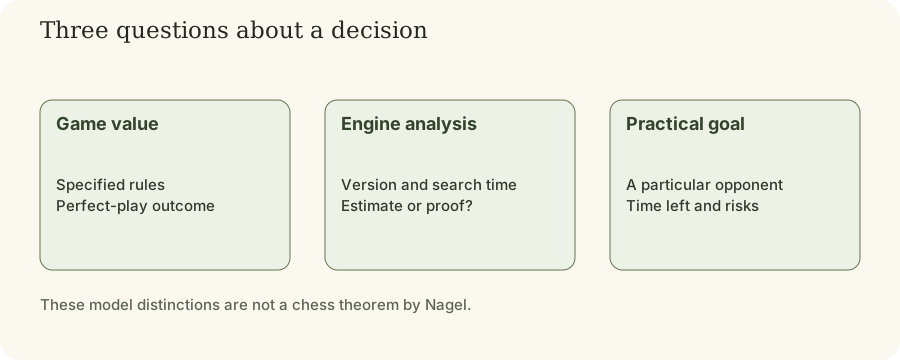
Two questions must also be separated: which move preserves the position’s value under optimal play, and how does the player reach a decision? Several moves can be equivalent for the first question while requiring different calculations or practical risks. Conversely, a line may contain only one move avoiding an immediate loss without removing the responsibility to understand, search or recognise an error.
The proposed interpretation therefore concerns commitment to a choice: explaining why you played that way, examining alternatives and accepting correction. It does not establish that rules prove free will or that an engine recommendation refutes it. The connection remains philosophical; a move’s value still requires chess analysis.
The question of objectivity in chess
In a finite game with specified rules, a value under perfect play can be defined. That value does not imply a uniquely best move: several continuations may preserve a win or a draw. The value of chess’s initial position has not been established, whereas certain simple positions or positions covered by tablebases can be solved under stated conditions.
An engine offers analysis within a given computational budget. Its version, settings and search duration matter; its first choice is not a universal proof of the exact value. When discussing objectivity, distinguish a verifiable forced mate, a tablebase result and an estimated advantage. These do not have the same status or limitations.
In the introduction to The View from Nowhere (1986), Thomas Nagel examines how to combine the perspective of a person situated in the world with a more detached understanding of that world. He does not establish two categories of chess truths, one absolute and another relative to a rulebook. Our connection is more modest: a player’s experience and impersonal position analysis address different questions that may be useful to consider together.
Changing the objective also changes the problem: seeking the optimal result under perfect play is not modelling the probability of beating this particular opponent with thirty seconds remaining. This distinction concerns the model’s definition, rather than a theorem attributed to Nagel. Before calling a move optimal, specify the criterion and the kind of justification available.
Chess and the limits of formal thought
Chess rules can be formalised. That does not mean everything interesting to a player, such as enjoyment or the story of a game, appears in the function used to score a move. However, leaving a dimension out of a chosen model does not prove that no other model could address it. First, it requires specifying what the model was intended to describe.
Gödel’s results (1931), particularly Proposition VI, concern undecidability in formal arithmetical systems under precise assumptions. They establish neither that the value of a finite game such as chess is undecidable nor that human thought is inherently superior to every machine. An exploration beyond current resources and a demonstrated impossibility are different concepts.
An engine’s understanding can still be discussed, but the change of question should be explicit. Comparing instructions, measured performance and lived experience does not automatically deliver a verdict on consciousness. A beautiful move as recounted by a player remains an interesting subject; its interest does not depend on a supposed chess consequence of Gödel’s theorem.
What philosophy learns from chess, and vice versa
Chess offers examples precise enough to test an interpretation. If you say a decision is forced, can you show why the alternatives fail? If you call it free, are you discussing legal possibilities, the player’s uncertainty or a philosophical account of action? The position does not answer everything, but it may reveal that two speakers use the same word differently.
Philosophy in turn invites examination of the analysis criteria: why choose this objective, what does understanding a rule mean, and what have we actually established? These questions can enrich game commentary without replacing endgame study or calculation. The cited texts demonstrate neither that philosophy readers play better nor that chess players automatically develop more rigorous general thinking.
To try this dialogue, revisit one decision from your last game. Record the move, an alternative and your justification at the time. After checking, separate proof, estimate and preference. This exercise is not a scientific method for general improvement; it simply helps make your reasoning explicit and recognise where the analogy stops explaining the position.
One board, three meanings of “best”
A coach calls a move best because it leaves a novice with an ending they understand. An analyst calls another move best because it preserves a theoretical win. A third player wants the move that offers the most chances against an opponent with ten seconds left. All three can agree on the legal moves, the material and the clock. Their disagreement is over what the recommendation is meant to achieve. Before invoking freedom, necessity or objectivity, try finishing the sentence “best for a player who wants to…”. Then ask which of your claims could be tested on the board and which would require knowing something about the people playing.
Sources
- Wittgenstein, L. (1953). Philosophical Investigations, §§31, 43 and 66–67. Full text, accessible bilingual edition. Section 31 concerns a piece’s use; §43 explicitly qualifies the scope of its formulation.
- Hegel, G. W. F. (1830). Encyclopaedia of the Philosophical Sciences, Logic, §§79–81. English translation of the passages. This article’s chess example is a proposed application, not a passage by Hegel.
- Sartre, J.-P. (1946). Existentialism Is a Humanism. English translation, discussions of existence, choice and responsibility.
- Nagel, T. (1986). The View from Nowhere, introduction, pp. 3–6. Oxford University Press preview, on relating subjective and objective perspectives.
- Gödel, K. (1931). On Formally Undecidable Propositions of Principia Mathematica and Related Systems, Proposition VI. Accessible English translation.
- Russell, S., & Norvig, P. (n.d.). Adversarial Search. Chapter and minimax example, for the distinction between game value, search and depth-limited evaluation.




Comments