
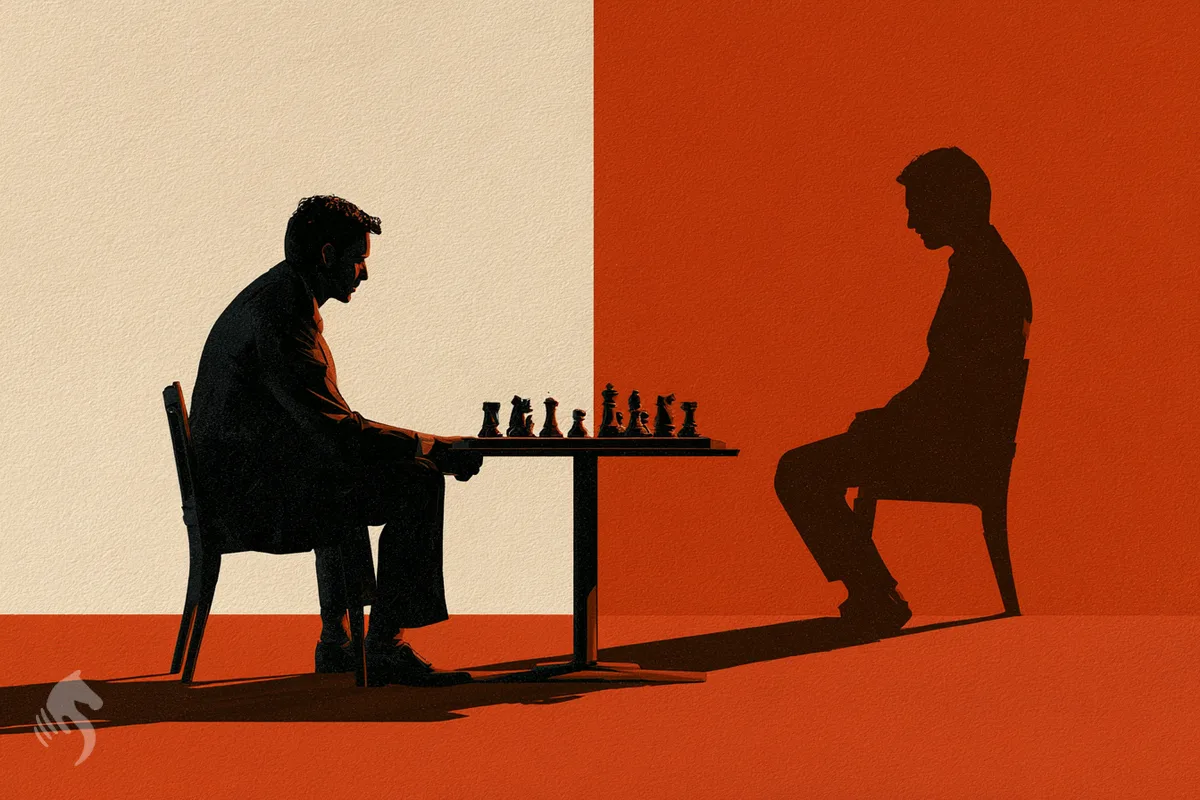
Before your hand even touches the first pawn, something has already happened. A faint tension settles in your shoulders. The opponent across from you looks at you a certain way, or perhaps does not look at you at all, which can be worse. You start calculating, but not variations: you calculate their level, their reputation, the rating gap between you. You wonder whether you are prepared enough. Part of the cognitive resources you planned for the board is already evaporating into that psychological noise.
Chess is unusual in how starkly it lays intelligence bare, as few disciplines do. Every mistake is irrefutable, recorded in the game's log. There is no luck to invoke, no teammate to blame, no bad weather that day. The chessboard holds up a merciless mirror. That is precisely why understanding your own psychology becomes, at a certain level, as important as knowing theoretical lines.
The goal: a map of your patterns (ego, tilt, impostor, zeitnot), not a list of generic tips, so the next game is a little less naive than the last.
Ego and outcome: playing to win vs. playing not to lose
There are two fundamentally different kinds of players, not by technical level but by deep intention when they sit at the board. The first plays to win. The second plays not to lose. The nuance looks tiny. In practice it is vast.
Playing not to lose is classic behavior of an ego wounded in advance. You have a rating to defend, a reputation in your club, a past win against this opponent you do not want to tarnish. You start solidifying your positions before you need to, avoiding tactical complications you did not initiate yourself, refusing imbalances that could help you but could also backfire. You play cautiously. You play fearfully. And very often you still lose, but this time in slow positional agony rather than bold attacking play.
Garry Kasparov, in his psychological analyses of the game, often described this duality as the border between ambition and fear. His most dangerous opponents were not those who knew opening theory best, but those who had nothing to lose psychologically, young prodigies who arrived at the table without the weight of reputation to protect. Psychological freedom is a formidable weapon on 64 squares.
Identity trapped in the Elo rating
The Elo system, designed by Arpad Elo as a neutral statistical performance measure, has become for many players something deeply intimate. The Elo number is no longer technical data; it has become identity. "I am a 1600." "I was 1900 last year." "I absolutely want to break 2000."
Merging self-worth with a floating number is psychologically costly. It turns every game into an existential threat. A loss no longer simply means "I played a bad game that night"; it means "I am less than I thought I was." Carol Dweck, psychologist at Stanford University, spent her career distinguishing two fundamental mindsets toward performance: fixed mindset and growth mindset. The player trapped by their Elo rating is textbook fixed mindset: every result confirms or denies what they "are," not what they "learn."
The player with a growth mindset looks at the same loss differently. It says: "There is something here I do not yet understand." The game becomes working material, not a verdict.
Off prep: intolerance of uncertainty, System 1 / 2, and the art of being uncomfortable
There is a fear many players at a certain level understand perfectly: fear of leaving theory. After ten or fifteen moves of polished prep, the opponent plays something unexpected. A subtle deviation. A move you do not have memorized. Suddenly you are alone with yourself, without the safety net of rote knowledge.
That feeling is psychologically analogous to what psychologists call intolerance of uncertainty. Some brains handle it with relative calm; others react with anxiety that paralyzes calculation. Daniel Kahneman formalized it in his two-system theory: in theory, your fast, intuitive, automated System 1 takes over, backed by memorized patterns. Off theory, your slow, conscious, laborious System 2 must do all the work. That is exhausting. And that sudden exhaustion can turn into panic if you are not trained to face it.
Petrosian and the art of feeling at home in chaos
There is only one healthy answer to that fear: deliberately train in discomfort. Tigran Petrosian, World Champion from 1963 to 1969, was a player who always seemed comfortable in complex, ambiguous, hard-to-evaluate positions. His style of preventive exchanges and deep defense was not cowardice. It was total psychological mastery: he felt more at ease in slightly worse but solid positions than in theoretically winning but volatile ones. He had made peace with uncertainty, and he exploited it against opponents who feared it.
Tilt: when emotion eats your calculation (and what it reveals about you)
If you have played more than a few dozen games in your life, you have lived it. An incomprehensible blunder. A forgotten pawn. A move that looked good and proved catastrophic. And suddenly something changes in how you play. You speed up. You calculate worse. You take absurd risks to "fix" a position that does not need it. You are on tilt.
The concept of tilt, borrowed from poker, describes the state where a player lets emotions dictate decisions instead of reason. Antonio Damasio, neuroscientist at the University of Southern California, showed in his work on somatic markers that emotions are not separable from decision-making: they are integral to it, whether you like it or not. The problem with tilt is not that you feel emotions (that is human and inevitable). The problem is that those emotions overpower rational evaluation of the position, skewing your judgment on every following move.
What tilt reveals about you
What fascinates about chess tilt is what it reveals about your psychological weak spots far beyond the game. If you systematically tilt after missing a sacrifice you did not calculate deeply enough, that says something about impulsivity. If you tilt after being out-prepared in the opening, that says something about ego and humiliation. If you tilt in long, slow endgames, that says something about boredom and patience.
Mark Dvoretsky, one of the greatest trainers in chess history, insisted on this with his students. Post-game analysis should not only hunt the technical error. It should hunt the emotional state in which that error was committed. That is where the real information lies.
When tilt becomes a repeated loop, games launched compulsively after every loss, something else is at work. The article Chess and addiction covers that case precisely.
Zeitnot: time does not kill you; fear of time does
The chess clock is a diabolical invention. It turns pure reasoning into an anxiety race against time. And worst of all, most amateur players mishandle their time not from lack of technique but from precise psychological mechanisms.
The first is what psychologists call analysis paralysis. When time runs low, the anxious player does not play faster: they calculate more. They seek THE perfect answer that would solve everything. Obviously that perfection does not exist, time keeps draining, and panic spirals. The calm player has learned to trust accumulated positional judgment to make reasonable decisions without recalculating everything from zero.
The second mechanism is self-fulfilling prophecy. You see your opponent has lots of time and you have little. Before even searching for the right move, you tell yourself mentally "I will lose on time." That conviction eats your remaining cognitive resources. You play hastily. And you actually lose on time not because you lacked time, but because you had already decided it was lost.
Too little or too much confidence: impostor, win streaks, and parasitized decisions
A psychological phenomenon rarely discussed in chess but extremely widespread is impostor syndrome. You have won a few tournaments, your rating climbed, people respect you at the club. And despite all that, a small inner voice whispers that you are not really up to it, that your results are luck, that sooner or later others will "see through you."
That feeling is especially toxic in chess because it pushes you into "demonstration mode" rather than "play mode." You try to prove you deserve your rating instead of simply seeking the best move on the board. Your decisions are parasitized by an imaginary audience.
The opposite exists too, and is equally dangerous: overconfidence after a streak of wins. The human brain naturally extrapolates recent trends. After five wins in a row, it is easy to underestimate an opponent, play with less rigor, take risks you would never have taken two weeks earlier. That is often where the most painful rating drops happen.
Flow: the rare state and conditions not to mythify
There are rare, precious moments every player has known at least once or twice in their practice where something different happens. The clock no longer exists. The room around you disappears. Your opponent is no longer a threat but simply the context of your thinking. You see the position with unusual clarity. Variations unfold naturally in your head as if already written.
Mihaly Csikszentmihalyi, psychologist at the University of Chicago, devoted his life to studying this state he called flow: total absorption in an activity, characterized by complete loss of time awareness, deep sense of control, and intense intrinsic satisfaction. Chess, according to Csikszentmihalyi himself, is one of the human activities that most easily and completely induces flow.
Conditions for flow on the board
Flow is not a gift from chance. It arises under very precise conditions. The fundamental one is perfect balance between task difficulty and the person's skills. Too easy, and the brain gets bored. Too hard, and it panics. In the narrow window where the challenge sits at the edge of your abilities without exceeding them, flow can emerge.
That practically means you cannot force flow. But you can create conditions that make it possible: be well rested, have studied enough that the material is not totally alien, play in a calm environment, and above all release all attachment to outcome. Paradoxically, it is often when you play without stakes in training games, in tournaments without rating pressure, that you touch your best performances.
Equanimity at the top: what Carlsen shows about mindset (without myth)
Magnus Carlsen embodies psychological fulfillment in chess better than anyone. Magnus Carlsen is often described as a technical genius. What people forget is that his real edge over opponents has often been psychological.
Carlsen has a particular gift: he seems to have no "favorite" position type. He plays equally well in balanced or imbalanced positions, simple endgames or tactical mazes. That strategic indifference is an absolute weapon. Opponents systematically try to steer the game toward a position type that might unsettle him. They fail because he seems to fear nothing in particular. That equanimity, the ability to maintain inner stability whatever the outer turbulence, is not natural. It is trained, cultivated, built through thousands of games played with the same intensity regardless of the position on the board.
What the board says about you (that you do not want to hear)
Chess psychology is not worked through like a checklist of goals. It is worked through defeat.
It is in the tilt move, in the game launched "just to fix it," in the instinctive refusal of complication that you truly reveal yourself. Not in your theoretical prep. Not in your current rating.
Real progress is not ceasing to fear losing. It is learning to play with that fear without letting it choose for you. The quality of your thinking is the only variable you really control. The outcome only belongs to you halfway.
The best player is often the clearest-eyed, not the strongest
The mental game in chess is not a mystical aura: it is a capacity to stay in the game when the position says you were wrong. Not to be indestructible, but to be less naive about your own patterns.
The chessboard holds up a merciless mirror. It shows how you react to pressure, how you handle fear and pride, how you get up after a mistake. It is not always comfortable. It is always instructive.
Key takeaways
- The gap between playing to win and playing not to lose is psychologically vast (Kasparov)
- Tilt is not weakness: it is a readable signal about your emotional patterns (Damasio, Dvoretsky)
- Flow (Csikszentmihalyi) emerges when the challenge sits at the edge of your skills, neither too easy nor crushing
- The quality of your thinking is the real variable of progress, not the game score
Sources and references
- Dweck, C. S. Mindset: The New Psychology of Success. Random House, 2006. (Fixed mindset vs. growth mindset theory applied to performance.)
- Csikszentmihalyi, M. Flow: The Psychology of Optimal Experience. Harper & Row, 1990. (Flow theory and its conditions in complex activities.)
- Kahneman, D. Thinking, Fast and Slow. Farrar, Straus and Giroux, 2011. (Systems 1 and 2 and implications for decisions under pressure.)
- Damasio, A. Descartes' Error: Emotion, Reason, and the Human Brain. Putnam, 1994. (Somatic markers and the role of emotion in rational decision.)
- Dvoretsky, M. Dvoretsky's Analytical Manual. Russell Enterprises, 2008. (Emotional analysis of errors in player development.)
- Gelfand, B., & Aagaard, J. Positional Decision Making in Chess. Quality Chess, 2015. (Psychological preparation and building a coherent playing style.)
Comments