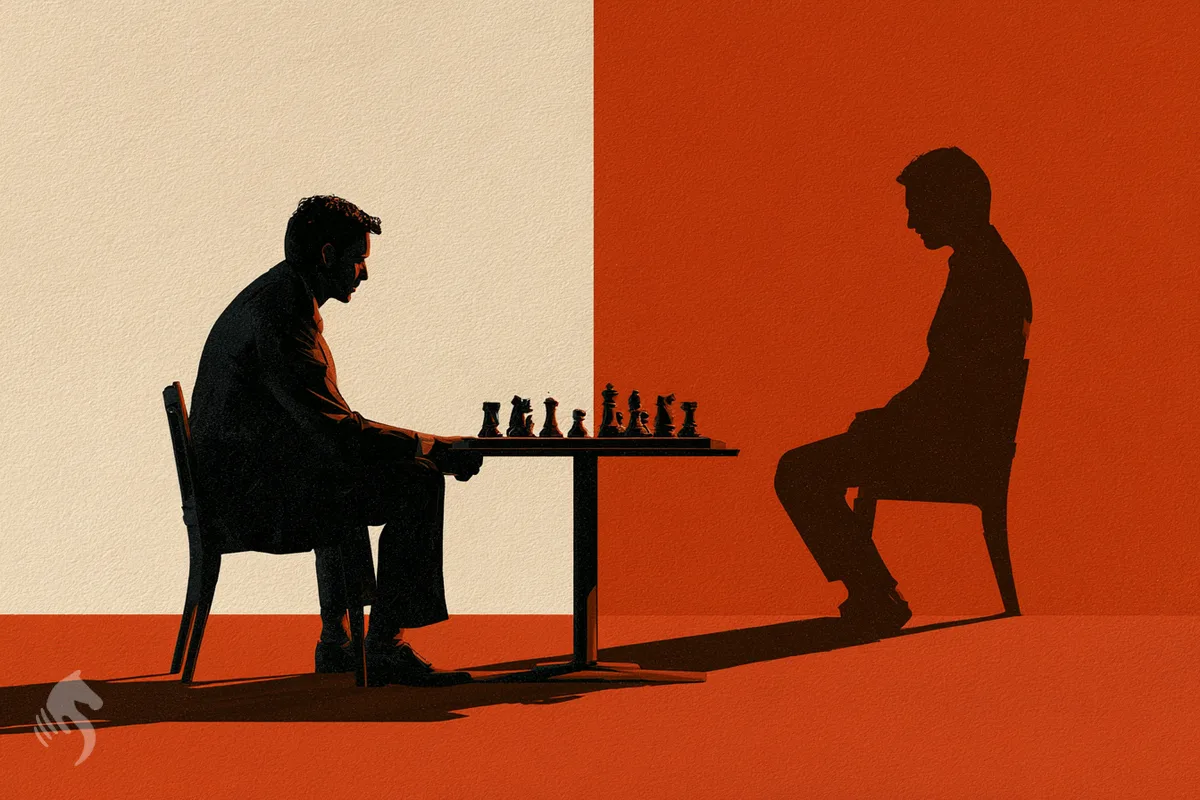
The Psychology of the Chess Player: What's Really Happening Inside Your Head
Chess isn't just played on the board. It's played first in your head, before your hand ever touches a piece. A psychological portrait of a player facing themselves.
Le mental, la discipline et la lucidité quand la pression monte.
Flipping the board, disconnecting, insulting your opponent. Anger in chess has a name: ragequit. And it has a precise neurological explanation that every player should understand.
Playing less to progress more: it sounds absurd, and yet cognitive recovery science explains why regular breaks are one of the most underestimated practices of the serious chess player.
Most players spend 80% of their time on openings. The 40-40-20 rule says the opposite: 40% tactics, 40% endgames, 20% openings. Why? And does it actually work?
You can polish openings and tactics and still face a zone engines don’t repair: your relationship to outcome, clock pressure, and self-image across the board. Competitive mindset isn’t motivational wallpaper : it’s how you frame uncertainty when the score can be mate or resignation.
This section takes psychology seriously without mystifying it. We discuss performance anxiety, emotion regulation, sustained attention, with angles relevant to club players and titled hopefuls alike. Few platitudes: frameworks to notice what happens during play, name it, then adjust with repeatable behaviors.
A mistake isn’t only a weak move; it often triggers a narrative (‘I’m hopeless’, ‘here we go again’) that hijacks later decisions. Conversely, a streak can intoxicate you into tactical sloppiness. Separating the material blunder from the identity story you tell about it is a skill, trained with simple protocols: breathing pauses, mini-checklists before critical moves, session journals.
Rating pressure can turn a statistical estimate into a moral badge. Useful reminder: Elo approximates strength; it doesn’t sentence your worth. Over-identifying makes you protect a number instead of playing the position, a costly distortion we unpack bluntly.
Confidence isn’t proclaimed; it accrues through evidence: honest game reviews, measurable session goals, tangible improvements. We also cover environment: club atmosphere, online toxicity, anonymous comments, forces that amplify stereotype threat or social comparison.
Expect realistic routines rather than self-help fluff: sleep and workload before events, clean endings to losses without rumination. Observable behaviors beat slogans.
Treat articles like field notes: pick one idea weekly, test it on a handful of games, log what shifts, or doesn’t. Player psychology advances through modest iterations, not lightning bolts.
If a piece uncomfortably describes you, good: the aim is useful lucidity that makes defeat survivable and wins less intoxicating. Tune your inner tempo as seriously as your analysis lines.
Short focal points to revisit after reading:
Time trouble, post-blunder spirals, adrenaline spikes : map sequences so you can interrupt them.
Escape ‘I am my rating’ traps : refocus on measurable process goals.
Clubs, forums, peers : how outside gaze loads your mind and how to lighten it.