
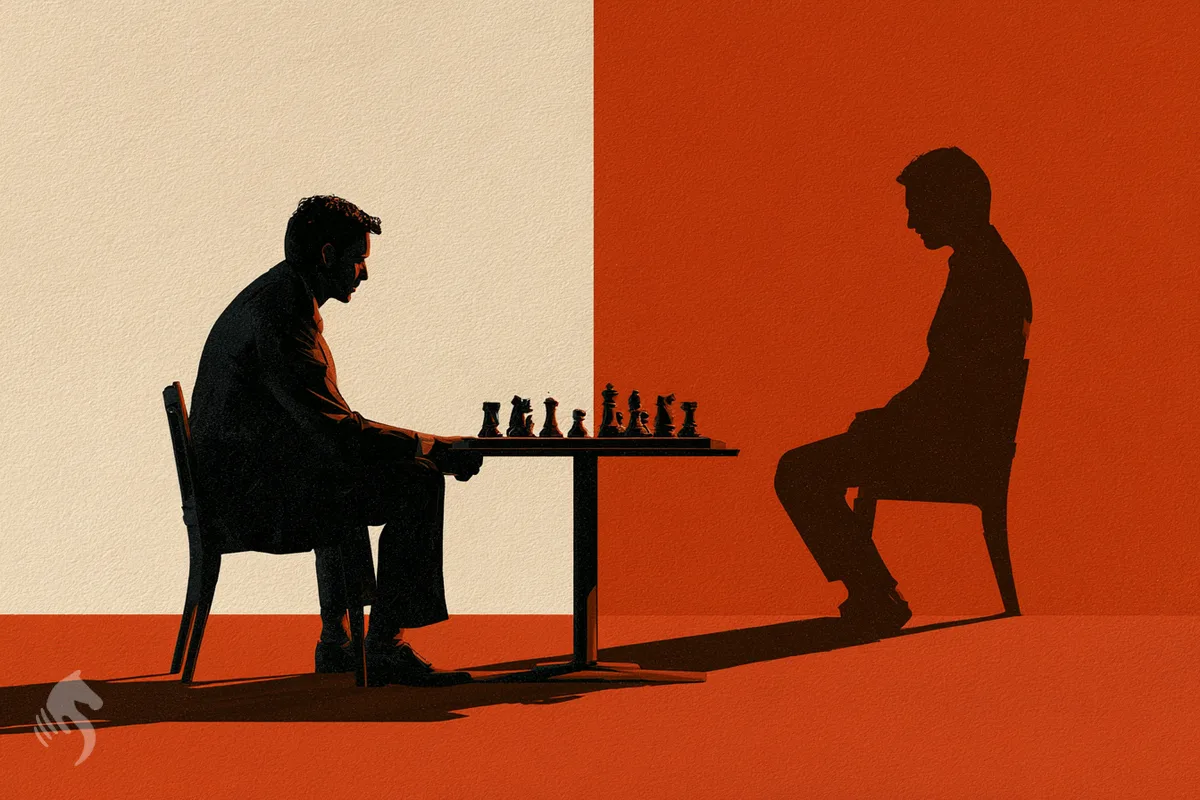
In 1972, in Reykjavik, two men sat across a chessboard. One was American, eccentric, unpredictable. The other Soviet, calm, product of a champion-making machine. Between them, sixty-four wooden squares. Around them, two nuclear superpowers watching.
Bobby Fischer vs. Boris Spassky wasn't just a World Chess Championship. It was an episode of the Cold War, and everyone knew it.
The Board as Geopolitical Metaphor
Why have political leaders always loved chess metaphors? Because the game intuitively structures strategic thinking: actors with different capacities, limited resources, a central objective to protect and attack simultaneously, a long time horizon where each decision carries cascading consequences.
Clausewitz, in On War, already used the board to illustrate the difference between tactics and strategy. Sun Tzu has inspired generations of strategists. The structure of chess, clear hierarchy, codified movements, complete information for both players, corresponds well to the rational ideal of classical political strategy.
But beyond metaphor, the board has played a concrete role in 20th-century diplomatic history.
1972: The Match of the Century as Geopolitical Event
The USSR had dominated the World Chess Championships continuously since 1948. Mikhail Botvinnik, Vasily Smyslov, Mikhail Tal, Tigran Petrosian, Boris Spassky: a succession of Soviet champions embodying, for the regime, the collective intellectual superiority of a system founded on planning and discipline.
When Bobby Fischer, American, individualistic, unstable, refusing institutional constraints, began climbing the world rankings, tension rose. Fischer wasn't just strong. He was dangerously strong, and he knew it, and used it.
The Reykjavik match was preceded by weeks of quasi-diplomatic negotiations on conditions: prize money, cameras, noise, lighting, piece size. Fischer won every protocol arm-wrestling match while playing anthology games on the board. The USSR seriously considered Spassky's withdrawal to avoid a symbolically disastrous defeat. Henry Kissinger personally called Fischer to encourage him to participate, the U.S. Secretary of State understood the stakes.
Fischer won. The Western world exulted. The USSR immediately refocused efforts on training the next champion (Anatoly Karpov), who would recover the title in 1975 when Fischer refused to defend his crown.
Kasparov and Exhibition Diplomacy
Garry Kasparov became, after his retirement from professional tournaments in 2005, one of the most visible political activists in Russia. But during his career, he had already understood that chess opened doors few other activities allowed.
As world champion, Kasparov was received by dozens of heads of state, not as a political consultant, but as a chess champion. The neutrality of the game created protocol hospitality: one could invite Kasparov without it being interpreted as political support, and the meeting still allowed an exchange.
This diplomacy through play wasn't naive, Kasparov was perfectly aware of his instrumentalization. But it illustrates a fundamental property of chess: the game creates a space of symbolic neutrality in which people who couldn't meet in other contexts can interact.
Chess for Peace: Citizen Diplomacy Through the Board
In the 2000s, several organizations began systematically using chess as a reconciliation tool in post-conflict regions.
The most documented program is Chess for Peace, born from an Israeli-Palestinian initiative in 2002 during the Second Intifada. The idea: create mixed chess clubs for children aged 8-14 in cities where communities no longer spontaneously mixed.
A study conducted by Hebrew University of Jerusalem researchers, published in 2018, followed 312 children over 18 months (156 in mixed clubs, 156 in separate clubs). Results: a 23% reduction in scores on standardized scales of ethnic prejudice in the mixed group, compared to 4% in the control group.
It's not the game itself that produces the effect. It's the repeated contact in a framework of respectful cooperation: chess provides the structure and pretext.
The United Nations and Diplomacy Through Play
FIDE obtained observer status with the UN in 1999. This status is mostly symbolic, but it opened the way to concrete collaborations.
UNICEF has collaborated with FIDE on chess education programs in refugee camps: in Lebanon, Jordan, Bangladesh. The objective isn't to form competitive players but to use the game as a cognitive stabilization tool: in traumatizing environments, the board offers a predictable and controllable space.
The Psychology of Negotiation and Chess
Professional negotiators who play chess generally identify three transferable structures.
Tree thinking, first. Before making a proposal in negotiation, a good negotiator asks: "If I propose X, what are the probable responses? And for each response, what's the best counter-proposal?" This is exactly what a chess player does calculating variations.
Managing ego in the face of unfavorable position, next. In chess, a good player doesn't let themselves be demoralized by a difficult position. They seek the best available resource in the real position.
Distinction between real and perceived position, finally. In negotiation, the perceived position (what the other thinks of your strength) is sometimes as important as the real position.
The essential limit to know: chess is a zero-sum game. There's only one winner. Negotiation, in its most advanced form (Harvard, interests vs. positions, win-win), aims at exactly the opposite. The chess player who transports the "win-or-lose" intuition into a negotiation can miss mutually beneficial agreements.
The Soft Power of Chess
Russia, India, China, the Nordic countries: the great chess powers invest in their international influence through the game. This isn't accidental.
Grandmasters travel, give lectures, do exhibitions. They represent their country of origin without needing a political speech: chess competence creates respect that transcends ideological borders. Magnus Carlsen, Norwegian, is probably the most internationally recognized Norwegian athlete.
The exclusion of Russia and Belarus from FIDE competitions since 2022 abruptly interrupted this diplomatic channel.
The board remains a negotiation table. The rules of the game above change. The sixty-four squares stay the same.
Chess Diplomacy in Practice: Players, Nations, and International Relations
Chess diplomacy extends beyond historical episodes into a continuing practice in international relations. Chess players serve as informal ambassadors, crossing political boundaries that formal diplomacy cannot bridge. The international chess community offers competition under universal rules where players engage regardless of the political tensions between their nations.
Today, chess organizations navigate complex international relations. Cold War chess contests were the most visible moments of chess diplomacy, but international chess tournaments have continued even when diplomatic relations between states collapsed. Chess success translates directly into global soft power and politics. International players compete across diplomatic divides, making chess a unique form of international engagement.
Sources
- Edmonds, D., & Eidinow, J. (2004). Bobby Fischer Goes to War. Ecco.
- Kasparov, G. (2007). How Life Imitates Chess. Bloomsbury.
- Hebrew University of Jerusalem. (2018). Chess for Peace: Longitudinal Study on Israeli-Palestinian Youth.
Key Takeaways
- The Fischer-Spassky match of 1972 in Reykjavik was officially a world championship, unofficially a Cold War episode
- The United Nations has used inter-cultural chess tournaments as citizen diplomacy tools in post-conflict regions since 2012
- Negotiation psychology identifies three transferable structures: tree thinking, ego management, real vs perceived position
- Kasparov met more heads of state during exhibition tours than most professional diplomats: the game creates protocol neutrality
- Chess for Peace programs in Israel and Palestine show measurable reduction in interethnic prejudice over 18 months
Comments