
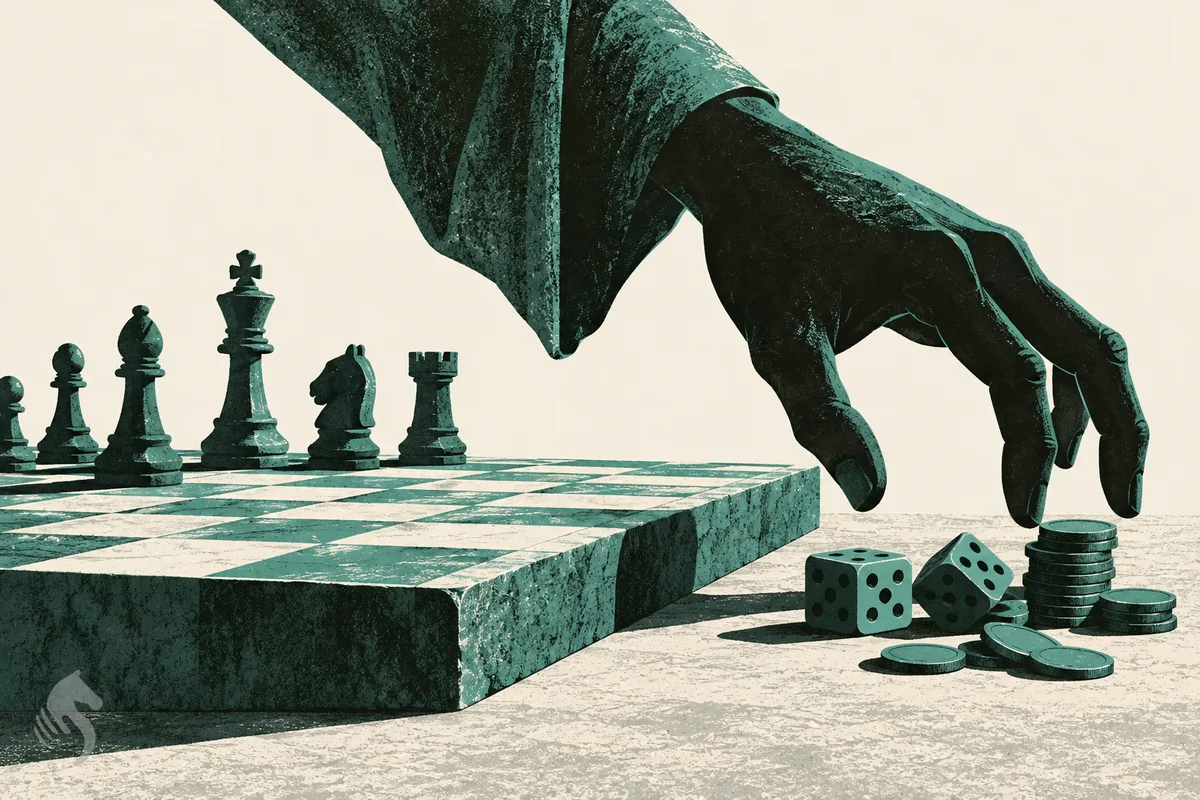
In January 2016, Saudi Arabia’s grand mufti declares chess impermissible. A few days later, a tournament nevertheless takes place in the kingdom.
Almost a thousand years earlier, around 1061, an Italian cardinal takes up his pen to rebuke a bishop found moving wooden pieces on a board. His tone is severe: a churchman should not endanger his soul with such entertainment.
Between those scenes lies a millennium of distrust. Latin Christianity, Islam and Russian Orthodoxy have, at different times, suspected, regulated or prohibited chess. What is striking when revisiting this history is how often the target extended beyond the game itself.
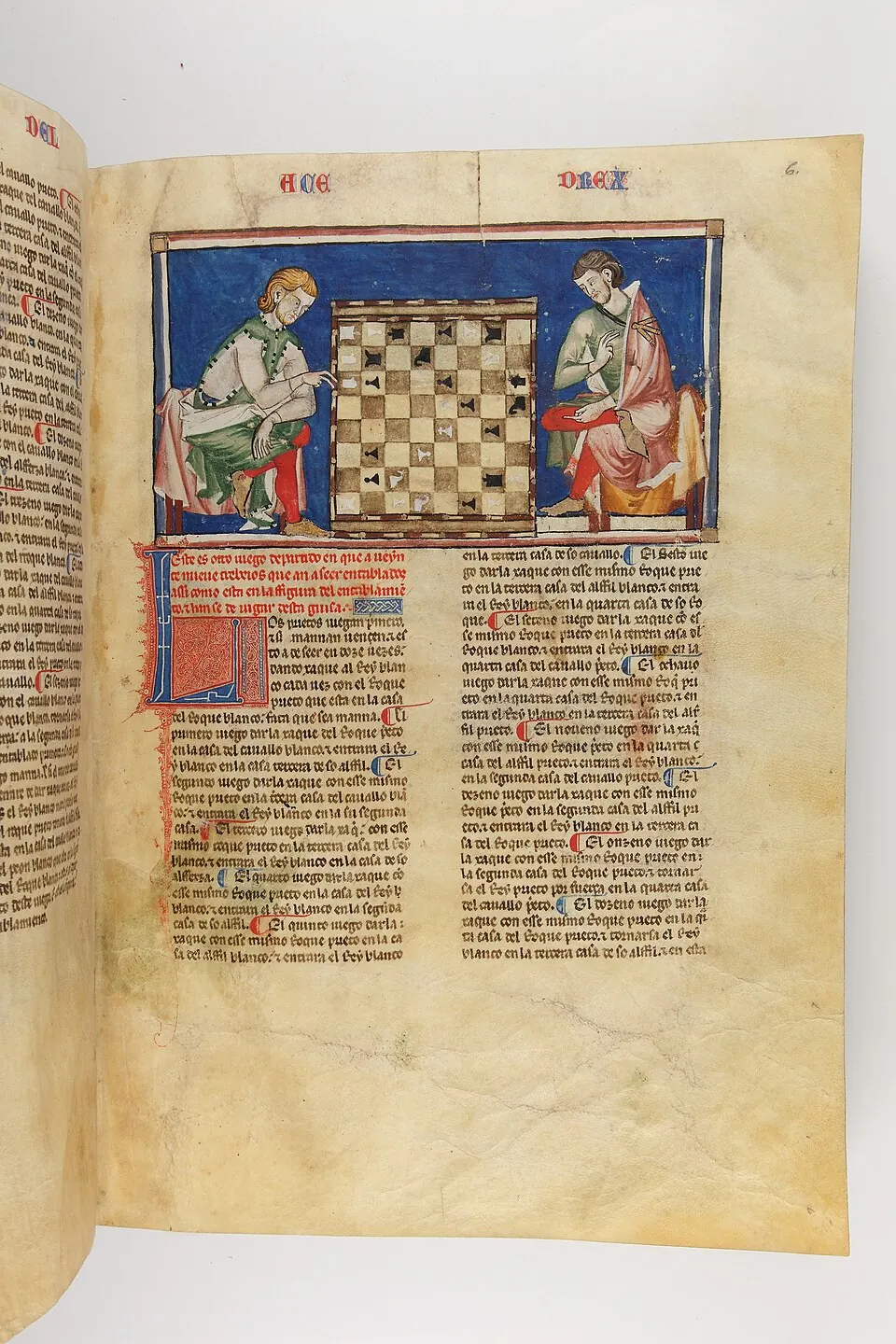
Why a board game troubled religious authorities
Before examining particular prohibitions, consider what could trouble spiritual authorities about a quiet game without apparent chance. Three concerns recur across centuries and traditions.
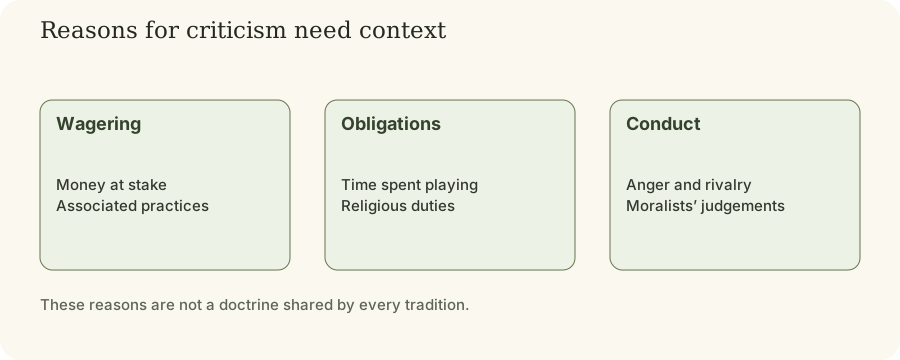
The first is money. Chess was not always played without stakes: people bet on a game’s outcome just as they wagered on dice. For medieval clerics and Muslim jurists, play and gambling could be closely associated. Wagering was widely condemned. The distinction between playing chess and gambling on chess was less clear than it is today, so the game could be condemned through that association. The historical relationship between the board and money deserves a separate examination.
The second concern is time. A chess game absorbs attention, makes hours disappear and can displace prayer, work and religious obligations. For an institution organising the day around services and duties, a game capable of consuming hours is a direct competitor. The complaint is less that the game itself is evil than that it draws the player away from God.
The third, subtler concern is the passions. Chess can awaken anger at defeat, pride in victory, humiliation and the desire for revenge. A moralist sees an activity stirring feelings that spiritual discipline seeks to quiet. A player’s outward calm can conceal considerable inner turmoil.
Keep those three themes in mind: money, time and passions. They help explain why restrictions arose and why removing the associated risks could make rehabilitation possible.
Medieval Christendom: the Church and the chessboard
Chess reaches western Europe around the year 1000 through Muslim Spain and southern Italy. It spreads rapidly among the aristocracy as a courtly game and a mark of refinement. Ecclesiastical reactions follow.
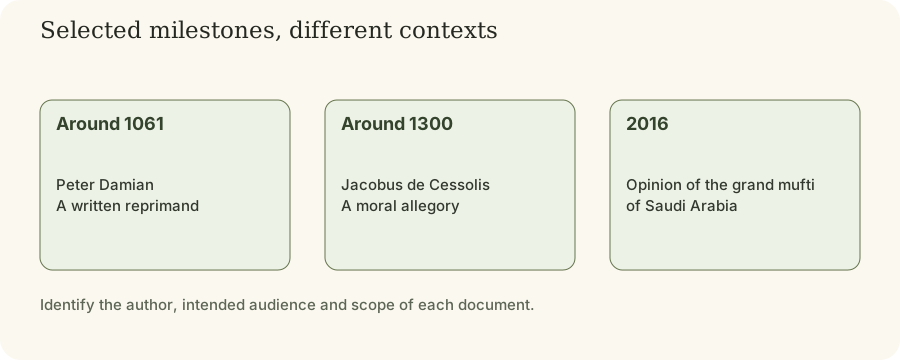
An early defining episode is attributed to Peter Damian, cardinal-bishop of Ostia and a major eleventh-century reformer. Around 1061, he writes an indignant letter concerning a bishop found playing chess. For Damian, a prelate lowering himself to a game associated with dice betrays his office. The episode, reported by historians of chess, establishes a lasting objection: chess belongs to idle laypeople, not clerics.
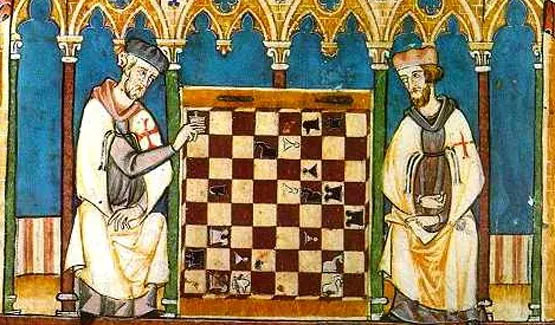
Restrictions subsequently accumulate. The Rule of the Knights Templar, drawn up around 1129, explicitly excludes chess as well as dice: the monk-soldier should devote his hours to fighting and prayer, not a board. Councils and synods in the twelfth and thirteenth centuries repeat restrictions for secular clergy. The twelfth-century Byzantine canonist John Zonaras also places chess among games condemned by earlier canons.
The ordinance of Saint Louis, issued in 1254, is another prominent expression of distrust. In a moral reform also directed at dice and taverns, the French king prohibits chess among games considered idle. Generations later, in Florence, the perceived vanity of gaming remains strong enough for chessboards to be included among objects destroyed in Savonarola’s bonfires in 1497.
Each episode returns to the same themes: association with wagering, time diverted from duties and passions thought unsuitable for a Christian.
The reversal: a chessboard becomes a moral lesson
Then the approach changes. Rather than directly confronting a game that proves difficult to eradicate, some religious writers choose to repurpose it. If the faithful cannot be stopped from playing, perhaps the game can teach virtue.
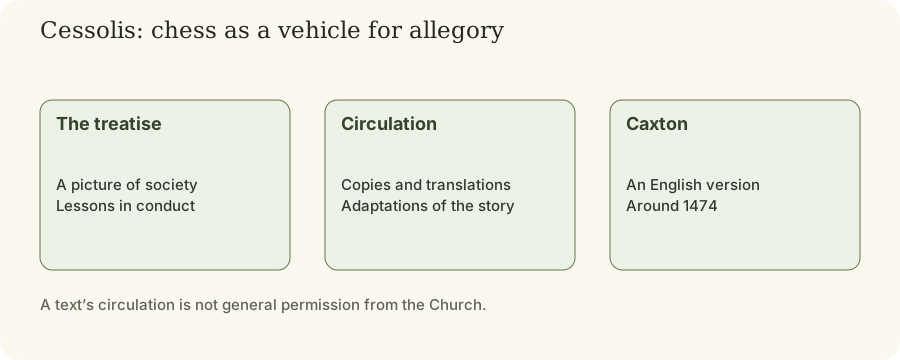
A central figure is the Dominican Jacobus de Cessolis, who writes a highly successful treatise around 1300: Liber de ludo scachorum, the Book of the Game of Chess. He makes the board an allegory of society. King and queen, bishops, knights and rooks represent social orders and functions; the eight pawns stand for ordinary occupations, including farmer, smith, merchant and weaver. Every piece and square provides an opportunity for a lesson about duties.
The method does not deny the game; it moralises it. Chess becomes a mirror of good government rather than an idle vanity. The treatise travels across Europe in copies, translations and adaptations. With printing, William Caxton publishes an English version, The Game and Playe of the Chesse, around 1474, among the earliest printed books in English. A game once treated as fit for destruction becomes an early subject of print culture.
From this point, chess becomes more acceptable in the Christian West. Money stakes can still attract suspicion, but the board itself is rehabilitated. During the Renaissance and Enlightenment, it becomes an emblem of intelligence and civility, a distant root of its present place in popular culture, a topic planned for a future article.
Islam: from suspicion to conditional tolerance
In the Muslim world, the history is older and more nuanced. Chess, or shatranj, reaches the Islamic world from Sasanian Persia, where it is called chatrang, after the seventh-century conquests. It soon attracts Baghdad’s educated elites, and leading players, the aliyat, enjoy considerable reputations.
The game immediately raises a question of religious law. Aniconism, reluctance to depict living figures, also helps explain why shatranj pieces become abstract and geometric, a form that travels to Europe and influences piece design. Above all, jurists ask whether play is permissible.
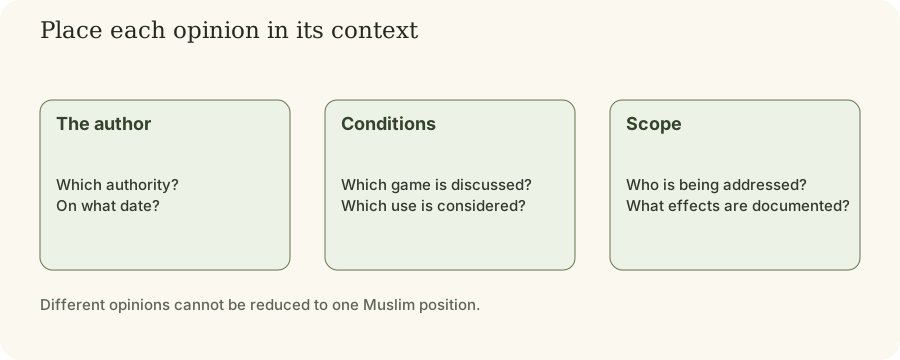
Their examination concerns the circumstances of play. Three conditions recur: no gambling, no neglect of prayer, and no harmful language or passions, such as swearing or anger. In this approach, the way a game is used matters to its religious assessment.
Legal schools differ. The Shafi‘i school is more accommodating, with a tradition that al-Shafi‘i himself played. Other currents lean towards disapproval, classifying chess as discouraged, makruh, or impermissible. This plurality helps explain later variation: no single position represents the whole of Islam.
Modern history offers two contrasting examples. In Iran, the revolution of 1979 marginalises chess as a suspected gambling activity. In 1988, Ayatollah Khomeini issues a fatwa permitting it when not used for gambling, helping revive Iranian chess. In January 2016, Saudi Grand Mufti Sheikh Abdulaziz Al ash-Sheikh declares chess impermissible, describing wasted time and money and hostility. Yet the opinion does not produce an effective ban: the Saudi federation says it is not legally binding, and a tournament follows. Moral condemnation and an actual prohibition again differ.
Orthodox Russia: prohibited by the Church, popular with players
Russia offers an especially striking case of a widely ignored prohibition followed by a dramatic reversal.
In the Middle Ages, the Russian Orthodox Church condemns chess. It inherits Byzantine canons classifying the game among disapproved entertainments, and ecclesiastical legal compilations prohibit it. On paper, playing chess is a fault.
Archaeological evidence tells a different story. Excavations, notably in Novgorod, recover many chess pieces from different social settings, suggesting widespread and continuing play despite clerical objections. Even the story of Ivan the Terrible’s death in 1584 places him at, or preparing to play at, a chessboard. Whether exact or embellished, the anecdote reflects the game’s place at the top of the state.
The reversal comes much later. In the twentieth century, the Soviet Union makes chess a state concern: schools, clubs, celebrated champions and a display of the regime’s claimed intellectual superiority. A pastime once condemned by church authorities becomes an instrument of influence on the diplomatic stage of the Cold War, a subject planned for another article. Religious restriction gives way to state prestige.
Judaism: a scholarly tolerance
Judaism offers a contrast to the other traditions. It has generally tolerated and sometimes valued chess as an intellectual exercise. Poems about the game are attributed to the twelfth-century poet and commentator Abraham ibn Ezra, and learned writers have praised it over the centuries.
A central discussion concerns Shabbat, the day of rest. The issue is whether an otherwise permitted game remains permissible when many ordinary activities are suspended. Authorities raise two familiar objections: recording moves amounts to writing, and the board might be treated as muktzeh, an object set aside that should not be handled that day. Responses include playing without recording and reserving particular chess sets, sometimes silver, for Shabbat so their festive use addresses the objection. The game is accommodated within ritual practice rather than simply expelled.
What these restrictions reveal
Return to the central theme. Religious traditions have, to varying degrees, tried to keep chess at a distance. Yet their concerns have often extended beyond what we now describe as an intellectual contest on sixty-four squares.
They targeted money wagered as on dice, time taken from prayer and duty, and passions, including anger, pride and revenge. The game was a visible focus for concerns older than itself.
Rehabilitation makes that distinction clear: removing monetary stakes and presenting chess as a lesson in virtue or government could reduce distrust. Cessolis did not change the rules; he changed the story told about the game. That reframing helped transform a condemned vanity into a subject of early English printing.
Viewed over this long period, the 2016 fatwa looks less isolated: it echoes an old fear that an absorbing game associated with wagering might draw people away from obligations. A millennium after Peter Damian, the argument is recognisable. Society has changed, however, and other arenas, such as professional earnings, cheating and women’s place in chess, now carry secular versions of longstanding moral questions.
Sources
- Murray, H. J. R. (1913). A History of Chess. Oxford University Press.
- Yalom, M. (2004). Birth of the Chess Queen: A History. HarperCollins.
- Cessolis, J. de (c. 1300). Liber de ludo scachorum. English translation by W. Caxton, The Game and Playe of the Chesse, c. 1474.
- Damian, P. (c. 1061). Letter concerning a bishop’s play, in Die Briefe des Petrus Damiani, MGH.
- Wilkinson, C. K. (1943). “Chessmen and Chess.” The Metropolitan Museum of Art Bulletin.
- Report: “Saudi grand mufti issues fatwa against chess,” The Guardian, January 2016.



Comments