
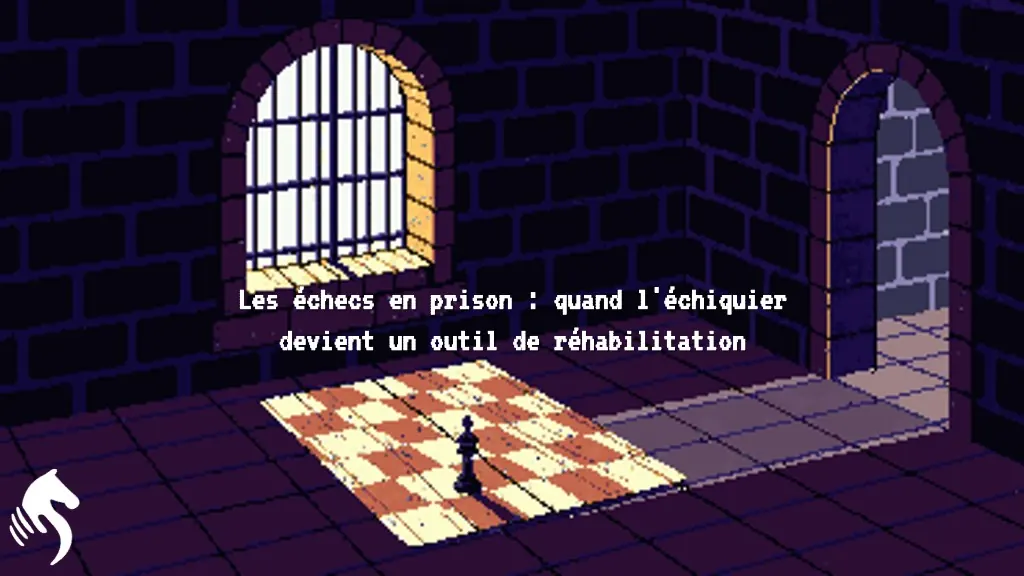
It is 2 p.m. in a prison on the outskirts of London. The room is small, the furniture battered. Two inmates sit facing a chessboard on a formica table. There is no close watch: the officer is in the corridor.
No phone. No television. Silence has settled naturally, rare enough here that other inmates pause at the door, curious.
One pushes a knight. The other thinks two minutes before replying.
What happens in that room is not symbolic. It is not recreation. It is deliberate. Since 2014 the British organisation Change Through Chess has worked in UK prisons with a clear aim: use chess not as a pastime but as a tool to develop cognitive functions tied directly to recidivism.
An inmate who learns to see three moves ahead on a board may also learn something about the consequences of decisions off the board. That hypothesis is no longer purely intuitive. It has grounding in modern criminology.
Why recidivism starts in the head
Contemporary criminology has gradually shifted focus. Behind well-documented social factors (poverty, exclusion, fractured families), specific cognitive profiles appear in recidivism research.
Ross and Fabiano formalised this link in the 1980s with their Reasoning and Rehabilitation programme: much repeat offending correlates with deficits in three precise cognitive domains.
Short-term thinking. Difficulty projecting distant consequences of an action. The immediate act weighs; what happens in three weeks or three years is hard to treat as a real decision variable. That is not moral blindness; it is a cognitive limit on temporal projection.
Impulsivity. Fast reactions to stimuli without enough inhibition time. The gap between emotion and action is too short or absent. Anger becomes a decision in seconds before the prefrontal cortex can weigh consequences.
Difficulty taking another's perspective. Weak theory of mind: trouble modelling what someone else thinks, feels, anticipates. Harmful acts toward others are often eased by failing to represent that other as a subject with an inner life.
Those three deficits are precisely the three axes a chess game trains, move after move, every session. When educators look for activities targeting inhibition, planning, and theory of mind, they often end up putting down a board. The fit is too tight to ignore.
Programmes that document outcomes
Change Through Chess (UK, since 2014)
Founded by educators and a former tournament player, Change Through Chess works in prisons, young-offender units, and resettlement centres across the UK.
Its approach is explicitly cognitive, not merely recreational. Sessions structure around three objectives tied to Ross and Fabiano's deficits:
Long-term planning: learn to see the position three or four moves ahead, not only the next move. Understand that each action creates a new reality with its own constraints.
Frustration management: lose a piece, land in a bad position, stay seated and think instead of walking away. The board forces you to face adversity calmly and look for a way out rather than flee or explode.
Opponent modelling: anticipating what the other will play means entering their perspective mentally. What do they see on the board? What do they want? What do they fear? That is the theory-of-mind exercise rehabilitation programmes try to build.
Reports published between 2017 and 2023 describe effects observed by prison educators: fewer disciplinary incidents in the weeks after sessions, better behaviour in prison classrooms, and in some cases reduced social isolation among participants.
These are internal reports, not randomised controlled trials. Interpret with caution. Their consistency with cognitive models of recidivism is striking.
From Rikers Island to San Quentin
In the United States prison chess programmes have a longer history. The chess club at San Quentin State Prison in California is among the best documented. Active for decades, it has produced several regionally competitive players and national media coverage.
What stands out in participant interviews is not playing strength. It is recurring phrases: "I learned to think before I acted." "I understood a bad decision has consequences you cannot erase." "Chess taught me to put myself in someone else's place."
Those phrases are not random anecdotes. They map exactly onto Ross and Fabiano's three deficits.
At Rikers Island, New York's jail complex, similar programmes sit inside broader education initiatives. Studies on the overall impact of prison education, of which cognitive programmes are one part, regularly show lower recidivism among participants. The RAND Corporation published a landmark meta-analysis in 2013.
Davis LM, et al. (2013). Evaluating the Effectiveness of Correctional Education. RAND Corporation.
That study, covering dozens of educational programmes in US prisons, estimated that inmates who participated in education had 43% lower odds of reincarceration within three years of release. It addresses education broadly, not chess specifically. But it places cognitive stimulation in a framework where impact on recidivism is now well documented.
France: local initiatives, no national programme
A frequent question in France: are there equivalent programmes? The answer is nuanced.
Punctual initiatives exist, run by local clubs, volunteers, and sometimes with support from the French Chess Federation. Games have been organised in prisons in Paris, Lyon, Marseille, often started by an educator or an inmate player who convinced administration.
There is still no structured national programme comparable to Change Through Chess in the UK. The French prison administration has no established chess protocol. It remains an open field.
What chess offers that other activities do not
The question deserves a direct answer: why chess rather than visual arts, sport, music, or theatre, all common in rehabilitation programmes?
Each activity trains different dimensions. What is specific to chess:
Failure is immediate, visible, and irreversible. In football a bad shot can be followed by a defensive recovery. In chess a played move stays played. The resulting position is the direct, irreversible consequence of your decision. That is learning about causality and personal responsibility with a clarity few activities provide.
The opponent is always respected, never physically dominated. In a prison where physical power dynamics are daily reality, the board imposes the opposite protocol: you win by thinking better, not by being stronger. Intellectual dominance is not only allowed; it is the only path. That inversion is symbolically powerful where physical hierarchy structures everything.
The game is universal and ignores pre-existing hierarchies. An inmate without formal education can beat someone with degrees. That fairness of starting position matters for people whose social experience often involves hierarchies felt as inaccessible or unjust. On the board nobody has a head start. Everything is built move by move.
Thinking becomes visible. In chess you cannot fake the quality of your reflection: the position shows everything. That transparency of thought (what I played reveals how I reasoned) can be a strong lever to help someone observe their own decision patterns.
The same mechanisms, other contexts
The cognitive deficits chess targets in prison (impulsivity, weak planning, difficulty modelling others) also appear in other profiles linked to social vulnerability. The article on chess and ADHD explores the same mechanisms for a neurodevelopmental profile common in custody: an estimated 25 to 40% of incarcerated people have undiagnosed ADHD.
That matters. If a large share of impulsive behaviour leading to incarceration is neurological rather than purely "moral," training executive functions (with chess among the tools) takes on added clarity.
Limits: neither romance nor naivety
Several cautions apply before claiming chess "saves" inmates.
Participant selection biases results. Inmates who volunteer for chess programmes likely already differ in motivation, desire to stand out, or how they use time, from those who do not. Measuring impact only on participants partly captures motivation effects, not necessarily chess effects.
Effects fade without follow-up. The strongest programmes combine chess with broader education and post-release support. The board alone, without context or follow-up, produces little lasting change. It is not a vaccine; it is training. Training must continue.
Rigorous studies are still scarce. Most data are observational, from organisations with incentives to highlight positive outcomes. Randomised controlled trials on this exact topic are rare. The field needs more independent, rigorous research.
Some custody profiles are poor fits. People with severe personality disorders, dissociative disorders, or histories of serious violence in competitive settings are not necessarily good candidates for group chess. Prior professional assessment matters.
These limits do not disqualify the approach. They frame honest interpretation.
Summary in one table
| Aspect | What the data suggest |
|---|---|
| Cognitive deficits and recidivism | Ross & Fabiano: impulsivity, short-term thinking, and weak theory of mind predict recidivism measurably. |
| What chess trains | Planning three to four moves ahead, inhibiting impulsivity, modelling the opponent: the three targeted deficits, move after move. |
| Available evidence | Change Through Chess reports (2017-2023), San Quentin testimonies, RAND meta-analysis on prison education (2013). Few direct randomised trials. |
| Main limitation | Selection bias: participants are often already motivated. Effects need follow-up to last. |
| Situation in France | Punctual initiatives but no structured national programme like the UK model. |
Key takeaways
- Contemporary criminology links three cognitive deficits to recidivism: short-term thinking, impulsivity, weak theory of mind (Ross & Fabiano, 1985)
- Those three deficits map onto three demands every chess game trains move after move
- Documented programmes (Change Through Chess, San Quentin) report observed effects on behaviour in custody, but randomised trials remain rare
- The main limitation of all such programmes: selection bias; participants are often already motivated to change
Sources and references
- Davis, L. M., Bozick, R., Steele, J. L., Saunders, J., & Miles, J. N. V. (2013). - Evaluating the Effectiveness of Correctional Education: A Meta-Analysis of Programs That Provide Education to Incarcerated Adults. RAND Corporation, RR-266-BJA. (Inmates in education programmes had 43% lower odds of reincarceration within three years of release.)
- Ross, R. R., & Fabiano, E. A. (1985). - Time to Think: A Cognitive Model of Delinquency Prevention and Offender Rehabilitation. Johnson City, TN: Institute of Social Sciences and Arts. (Links cognitive deficits, short-term thinking, impulsivity, weak theory of mind, to repeat offending.)
- Change Through Chess (2017-2023). - Programme Reports. changethroughchess.com. (Annual reports on observed effects for incarcerated participants in the UK: emotion regulation, behaviour in custody, engagement in education.)
- Fazel, S., Doll, H., & Långström, N. (2008). - Mental disorders among adolescents in juvenile detention and correctional facilities: A systematic review and metaregression analysis of 25 surveys. Journal of the American Academy of Child & Adolescent Psychiatry, 47(9), 1010-1019. (High prevalence of ADHD and neuropsychiatric conditions in custody populations, supporting cognitive interventions.)
- Hare, R. D. (2006). - Psychopathy: A clinical and forensic overview. Psychiatric Clinics of North America, 29(3), 709-724. (Framework for custody profiles and limits of cognitive interventions by profile.)




Comments