
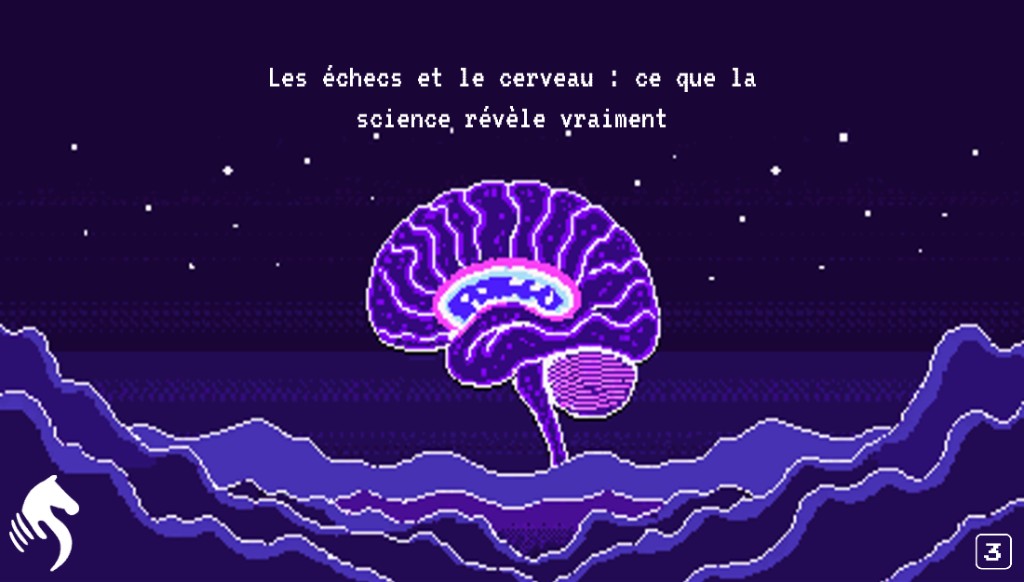
It is not an exceptional brain that lets you play chess brilliantly. Relentless chess practice builds an exceptional brain. The image of the grandmaster born with a divine gift is exactly backwards.
Our brain is not a machine fixed at birth: it is modeling clay that rewires, repairs, and optimizes itself based on the challenges we throw at it. After this, you will not look at your post-game fatigue the same way.
The illusion of innate intelligence: it is not what you think
For a long time, popular belief (and even part of the scientific community) held that chess champions possessed globally above-average intelligence, a sort of natural "chess IQ." The idea was simple: if you shine at chess, you must be a little genius at mathematics, logic, and spatial reasoning.
Yet when researchers began giving international masters general cognitive test batteries, the results were at least puzzling. Away from the board, on tasks like memorizing random words or solving everyday problems, most of these champions scored perfectly normal. They did not have absolute super-memory. If you asked them to remember a shopping list or strings of meaningless digits, they did no better than you or me.
The real scientific breakthrough came when the impact of neuroplasticity became clear. Your brain runs on a very strict economic principle: "Use it or lose it." Every time you learn to spot a pin, a fork, or a mating net, you force neurons to create new synapses, new communication routes. With repetition, those little neural dirt paths turn into real information highways. Chess intelligence is not a gift from above; it is the result of a huge, ongoing construction site in the brain. It is not that these players are smarter by nature; it is that their brain has allocated colossal resources to excel in this specific environment.
The grandmasters' secret: "chunking" theory
If grandmasters do not have extraordinary general memory, how can they play blindfold against ten opponents or remember a game from twenty years ago? The answer comes from major work by Fernand Gobet, researcher at the University of Liverpool and a world specialist in the psychology of expertise.
Fernand Gobet built on foundational research to develop and refine "chunking" theory (roughly "grouping" or "blocking" information). The idea is brilliantly simple. When you look at a chess position, you see 32 individual pieces scattered across 64 squares. A beginner's or amateur's brain is saturated by that huge amount of isolated information.
The grandmaster does not see individual pieces at all. Their brain automatically groups pieces into "chunks," blocks of meaning. They do not see a pawn on f2, a pawn on g2, a pawn on h2, and a King on g1. They see "intact white kingside castling." They perceive patterns, visual motifs, constellations of pieces they have already encountered tens of thousands of times.
Gobet's studies show that a professional player holds between 50,000 and 300,000 such "chunks" (or "templates," more complex models) in long-term memory. It is exactly like learning to read. A child spells letter by letter ("M-A-I-S-O-N"), which costs enormous cognitive effort. You read the word "HOUSE" instantly, as a single block. Grandmasters "read" the board. That massive visual library lets them play at lightning speed, not through superhuman depth calculation of fifty moves. Their brain has optimized visual storage to get around the natural limits of human working memory.
That same ability to recognize patterns, and why it comes naturally to some cognitive profiles, is central to the article Chess and autism.
What really lights up under a scanner
Cognitive psychology explains behavior, but modern neuroscience lets us see the brain literally in action. Researchers placed players of different levels in functional MRI scanners to see which areas activated while they solved tactical problems. The results, published notably in prestigious journals like the Journal of Neuroscience, are fascinating because they show that a novice's brain and an expert's brain do not work the same way physiologically on the same problem.
When a beginner analyzes a position, the medial temporal lobe lights up dramatically. This brain region is heavily involved in forming new memories and consciously processing unfamiliar information. The beginner sweats; their brain burns huge energy trying to understand what is going on, because every position is terra incognita they must painfully decode.
By contrast, for the grandmaster facing the same position, the medial temporal lobe stays surprisingly calm. The frontal and parietal cortices take over. These areas are tied to retrieving long-stored memories and pattern recognition. Physiologically, the expert is not "searching" for the solution through brute effort; they are "retrieving" the solution from their neural database.
The chessboard thus reshapes the geography of mental effort. With years of practice, the brain shifts workload: it moves from slow, conscious, energy-hungry calculation (psychologist Daniel Kahneman's System 2) to fast, economical visual recognition (System 1). Playing chess is literally teaching your brain to save energy by automating excellence.
Why playing chess your whole life protects the aging brain
If chess changes how our brain processes visual and spatial information, does it affect the overall health of our gray matter long term? Here we touch one of the most crucial chess benefits for the brain: "cognitive reserve."
We know today that our brain ages naturally. Synaptic connections tend to weaken, and neurodegenerative diseases can set in. But science has found that people who engage their brain in intellectually demanding, complex, regular activities throughout life develop a form of neurological shield.
By forcing your brain to analyze, calculate, memorize openings, and solve problems under time pressure, you encourage the growth of new dendrites (the branches of neurons). That increased neural density creates what we call cognitive reserve. Picture it like a road network: if you only have one road from town A to town B and it is blocked, you are stuck. If, thanks to chess, you have built a dense network of small side roads, your brain will always find a detour after injury or aging.
The Verghese et al. study (New England Journal of Medicine, 2003), following 469 older adults for five years, showed that regular board-game play, including chess, was associated with a 74% reduction in dementia risk. Like musicians or bilingual people, dedicated chess players seem to benefit from greater cognitive reserve. Careful: chess does not cure disease, but it is first-class brain gymnastics for keeping the brain elastic and robust as we age.
Beyond memory: managing uncertainty and emotions
The brain is not just a calculator; it is also the center of our emotions. Reducing chess benefits to memory and spatial geometry misses its most underestimated dimension. And the chessboard is an emotional theater of rare brutality.
Science is increasingly interested in how chess trains the prefrontal cortex, the brain region responsible for executive functions: decision-making, planning, but above all inhibitory control. When you desperately want to capture an opponent's Queen served on a silver platter, instinct screams at you to go for it. Your prefrontal cortex, strengthened by years of practice, activates to brake that primal impulse and whisper: "Wait, calculate first. Is it a trap?"
This repeated training in mastering impulsivity has fascinating ripple effects. Chess players learn to manage extreme uncertainty. They habituate their brain to working under time pressure, to accepting that the opponent destroys their plans, and to coldly reassessing without letting cortisol (the stress hormone) paralyze their thinking.
The chessboard then becomes a school of neurological resilience. You teach your brain to separate emotion (fear of losing, thrill of winning) from the logical, mathematical analysis of the position. Maybe that is the real superpower of chess players.
Long-term chess practice literally reorganizes the brain: geography of effort, cognitive reserves, impulse control. Not an opinion: fMRI, scanners, and decades of cognitive studies back it up.
The Magnus Carlsen case: what MRIs do not show
Magnus Carlsen had a scan in 2015 for a Norwegian documentary project. Result: a normal brain, no special architecture. Nothing that distinguishes a World Champion from an accountant in Bergen. What the scanner misses is functional geography: which areas light up, how fast, with what degree of automation. Carlsen started playing seriously at age eight. Thirty years of intensive practice shifted positional work toward fast-recognition zones, exactly the medial temporal to frontal transfer described above. His brain no longer "calculates" elementary positions. It reads them. The apparent speed of his decisions is not genius: it is accumulated neuroplasticity, move after move, since childhood.
After reading: the next time you leave a long game drained, ask which areas just worked hard, then favour one slow analysed game weekly over five blitz games to consolidate the gains.
Key takeaways
- Grandmasters do not have higher IQs: they carry a library of 50,000 to 300,000 memorized "chunks" (Gobet)
- Chess practice shifts cognitive work toward fast visual recognition, measurable on MRI (Atherton, 2003)
- Studies suggest that dedicated players develop protective cognitive reserve against aging (Verghese, NEJM 2003)
- The chessboard trains the prefrontal cortex: inhibitory control, decision-making under pressure
Sources and references
- Gobet, F., & Charness, N. Expertise in Chess, In The Cambridge Handbook of Expertise and Expert Performance, Cambridge University Press, 2006. ("Chunking" theory and grandmaster memory.)
- Atherton, M., Zhuang, J., et al. A functional MRI study of high-level cognition. I. The game of chess. Cognitive Brain Research, 2003. (Differential novice vs. expert brain activation.)
- Kahneman, D. Thinking, Fast and Slow, Farrar, Straus and Giroux, 2011. (Brain energy savings and automation of expertise.)
- Frith, U. & Blakemore, S. The Learning Brain: Lessons for Education, Blackwell, 2005. (Neuroplasticity and long-term learning.)
- Verghese, J., Lipton, R. B., Katz, M. J., et al. - Leisure Activities and the Risk of Dementia in the Elderly. New England Journal of Medicine, 348(25), 2508-2516, 2003. (469 older adults followed for 5 years: board games associated with a 74% reduction in dementia risk.)
Comments