
Imagine you're calculating a 6-move variation. You mentally advance the pawn, your opponent responds with the knight, you develop the bishop, the knight jumps again, your rook enters the game, and,
You've lost the thread. You no longer know exactly where the black knight was after the fourth move.
This frustrating moment of forgetting is not due to a lack of intelligence or effort. It's your working memory reaching its limit.
Baddeley's Model: What Working Memory Really Is
Alan Baddeley, a British cognitive psychologist, published his working memory model in 1974, a model that remains, with some updates, the reference in cognitive neuroscience fifty years later.
Working memory is not simple temporary storage. It's an active system for maintaining and manipulating information during processing. It has several components:
The central executive: an executive system that coordinates everything, allocates attentional resources, and manages exchanges between subsystems.
The phonological loop: maintains verbal and auditory information (the "words in your head," mental arithmetic calculations you verbalize internally).
The visuospatial sketchpad: maintains visual and spatial information, this is the component most engaged in chess, for maintaining the board and piece representation during variation calculation.
The episodic buffer: integrates information from different subsystems with long-term memory, the "glue" linking working memory to stored knowledge.
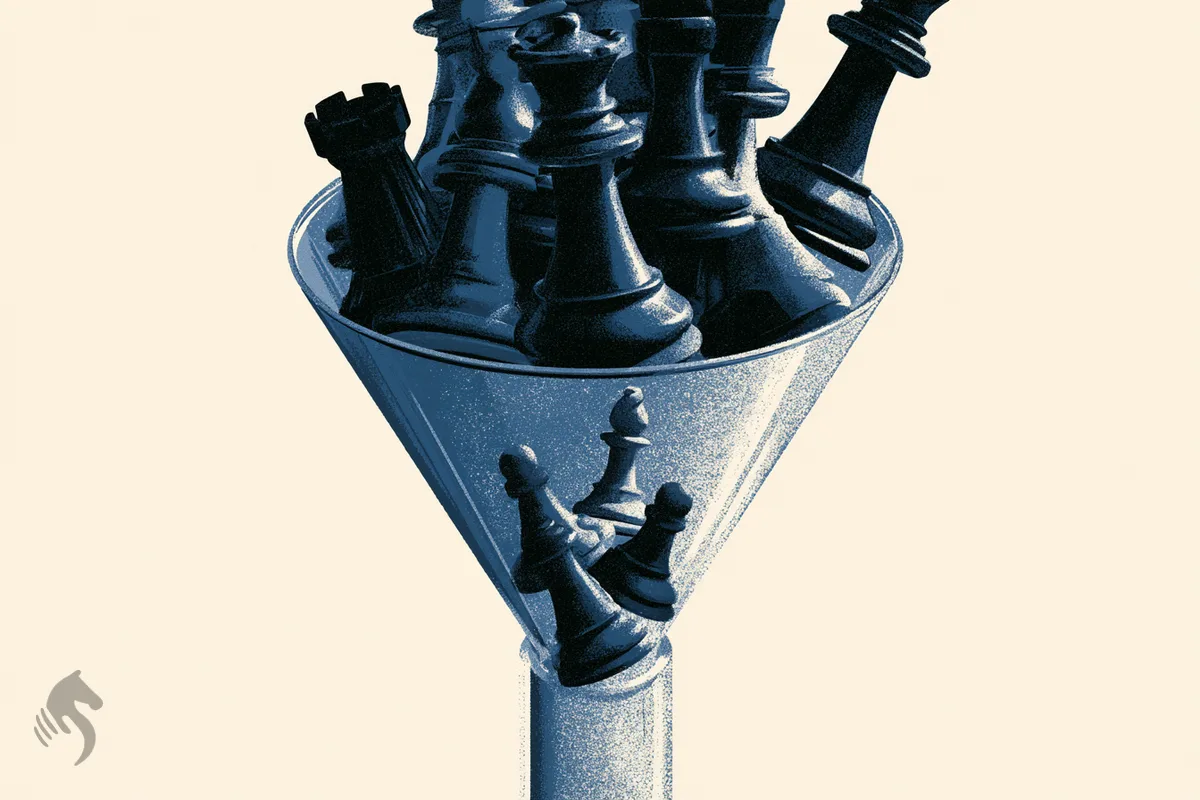
The total capacity of this system is limited: approximately 4 to 7 elements simultaneously, depending on the nature of the information and the level of expertise. Beyond that, old information begins to "leak", it exits working memory before being processed or transferred to long-term memory.
Why Chess Saturates Working Memory
An ongoing chess game simultaneously demands several working memory resources:
The current position: even though the board is visible, the player must maintain a mental representation of the position to use in calculation.
Calculated variations: each "if I play A, they play B, I respond C..." requires maintaining a sequence of successive positions, each differing from the previous by one or more moves.
Opponent's threats: identifying and tracking the opponent's active threats is a distinct working memory load.
Strategic plans: keeping a medium-term plan in mind (preparing a kingside attack, improving the knight via a specific square, creating a passed pawn) while calculating immediate tactical variations.
Each of these demands consumes working memory capacity. In a simple position, the load is manageable. In a tactically complex position (multiple simultaneous threats, a sacrifice to evaluate), the load can exceed available capacity.
The result: surveillance errors. You forget a piece you noted as threatened three moves ago. You lose sight of an opponent counter-threat you saw during calculation. You play a line you partially calculated but didn't finish, lacking capacity to go further.
The Illusion of Extended Expert Memory
Why do grandmasters seem to have far superior working memory compared to novices?
They don't, fundamentally. Their "raw" working memory (measured on neutral tasks unrelated to chess) is comparable to non-players of the same age and education group.
What they have is a library of chunks: piece configurations stored in long-term memory as units. When an expert sees a position, they don't decompose it into 20 individual pieces. They recognize it as "classic short castle + knight on f6 + typical Sicilian pawn structure", 3 chunks instead of 20 elements.
This compression frees working memory capacity for calculating new variations. The expert doesn't need to mentally maintain all the pieces of the position: they stored the "base position" as a chunk and can retrieve details from long-term memory when needed.
This is why the Chase and Simon (1973) study showed that experts had no better memory for random positions: in that case, chunks don't apply and the advantage disappears.
Training Working Memory for Chess
The good news: working memory is trainable. The less good news: training is specific, improving at chess calculation improves working memory for chess, with partial transfer to other domains.
Chess-specific exercises:
Calculate without touching: force yourself to mentally calculate every variation to completion before playing. Progressively increase the target depth (2 moves → 3 moves → 4 moves).
Blindfold tactical problems: look at a position for 30 seconds, close your eyes, calculate the solution. Closing your eyes forces exclusive use of the visuospatial working memory.
Replay from memory: choose a famous game (known up to move 15-20) and replay it from memory without looking at the book, checking afterward.
General exercises:
Dual N-back (a laboratory task where you must identify if a stimulus matches the one presented N items earlier, on two simultaneous streams) is one of the few cognitive training methods showing measurable effects on general working memory.
Aerobic activity (walking, running, cycling) improves working memory through a vascular mechanism: increased blood flow in the prefrontal cortex improves its efficiency. Studies show 15-20% improvements on working memory tests after 8 weeks of regular aerobic exercise.
The Limits to Know
Working memory training has important limits that research has clarified in the last ten years.
Effects are primarily specific to the trained task, with limited transfer to distant tasks.
Effects are temporary without maintenance. Working memory is not a muscle that stays strong once developed: it requires regular practice to maintain improvements.
Working memory has biological limits that are not infinitely expandable. You can optimize its use (via chunks, compression strategies, reducing cognitive noise), but you cannot double its capacity through training. Grandmasters are remarkable not because their working memory is twice as large, but because they use the same capacity with twice the efficiency.
That's the real lesson: the bottleneck is real. Chess skill is largely the art of optimizing what passes through this bottleneck.
Sources
- Baddeley, A. D., & Hitch, G. (1974). Working memory. In G. H. Bower (Ed.), The Psychology of Learning and Motivation (Vol. 8, pp. 47-89). Academic Press.
- Chase, W. G., & Simon, H. A. (1973). Perception in chess. Cognitive Psychology, 4(1), 55-81.
- Cowan, N. (2001). The magical number 4 in short-term memory. Behavioral and Brain Sciences, 24(1), 87-114.
- Miller, G. A. (1956). The magical number seven, plus or minus two. Psychological Review, 63(2), 81-97.
Key Takeaways
- Working memory (Baddeley, 1974) is a system for temporarily maintaining and manipulating information, with a capacity of approximately 4-7 chunks simultaneously
- In chess, working memory is stressed to maintain simultaneously: the starting position, calculated variations, opponent threats, and long-term strategic plans
- Expert chess players appear to have "extended" working memory, but it's an illusion: they use long-term memory (stored chunks) to compress information
- Working memory declines with age but is trainable: specific programs show measurable improvements in 4-8 weeks
- Dual-task conditions (distractions, noise) degrade working memory by 20-40%: explaining why the playing environment has a real impact on decision quality

Comments