
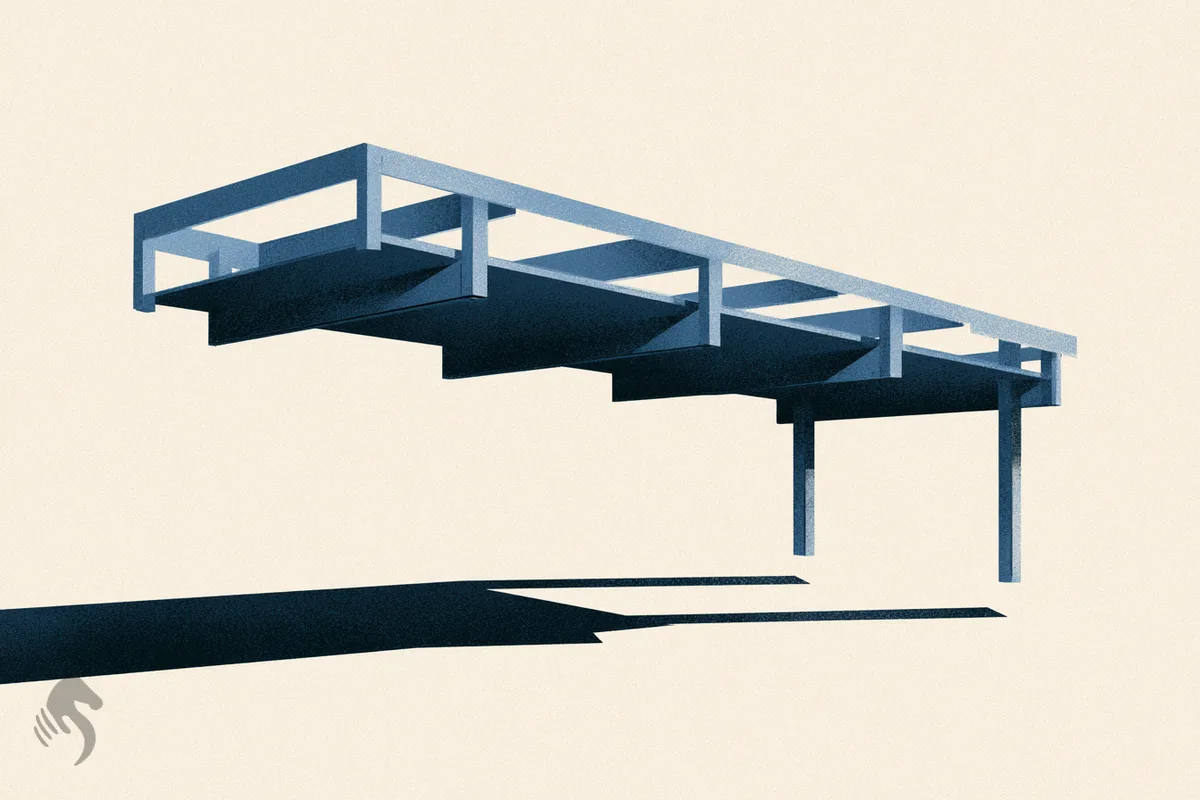
Viswanathan Anand played 8 chess games simultaneously, blindfolded, without seeing a single board, beating all his opponents. In his head: 8 different positions, each with dozens of pieces, distinct game histories, plans and counter-plans, all maintained simultaneously for hours.
This isn't magic. It's spatial visualization pushed to its limits, a capacity that chess develops in documented ways, and that neuroscience is beginning to understand in depth.
Spatial Cognition: What Are We Talking About?
Spatial cognition refers to the set of mental capacities that allow representing, transforming, and navigating in space, whether physical (finding your way in a building) or abstract (visualizing a molecular structure in chemistry, reading an architectural blueprint).
Researchers generally distinguish several components:
Spatial visualization: The capacity to mentally manipulate two-dimensional or three-dimensional objects, rotate them, assemble them, imagine their appearance from different angles.
Spatial memory: The capacity to memorize and recall positions and configurations, where the pieces were at the end of the middlegame, what the pawn structure looked like 10 moves ago.
Spatial reasoning: The capacity to use space to solve problems, inferring that a piece on c5 controls certain squares, predicting piece trajectories, understanding geometric relationships between squares.
All three components are engaged in chess, to different degrees depending on the game phase.
The Tejada-Gallardo Meta-Analysis (2021)
The most rigorous study on the link between chess and spatial cognition is the meta-analysis by Tejada-Gallardo et al. (2021), published in Educational Psychology Review.
The authors selected 17 studies meeting minimum methodological quality criteria, covering children and adults at varying levels. The overall effect on spatial reasoning is ES = 0.54: a medium-to-strong effect, significant and robust across studies.
Key points from this meta-analysis:
- The effect is stronger for children (6-12 years) than for adults, suggesting that developmental period influences spatial plasticity
- The effect is stronger for intervention studies (chess courses) than for cross-sectional studies (comparing players vs non-players), suggesting causality rather than mere selection
- Instruction duration modulates the effect: programs exceeding 30 hours produce larger effects
What Grandmasters Actually See
The popular idea that grandmasters have photographic memory of the board is a myth, documented as such since Adriaan de Groot's work in the 1940s and refined since.
The reality is more interesting.
Schematic, Not Photographic Representation
Studies of verbal protocols and eye-tracking show that experts don't uniformly scan all squares, they saccade toward zones relevant to their current variation.
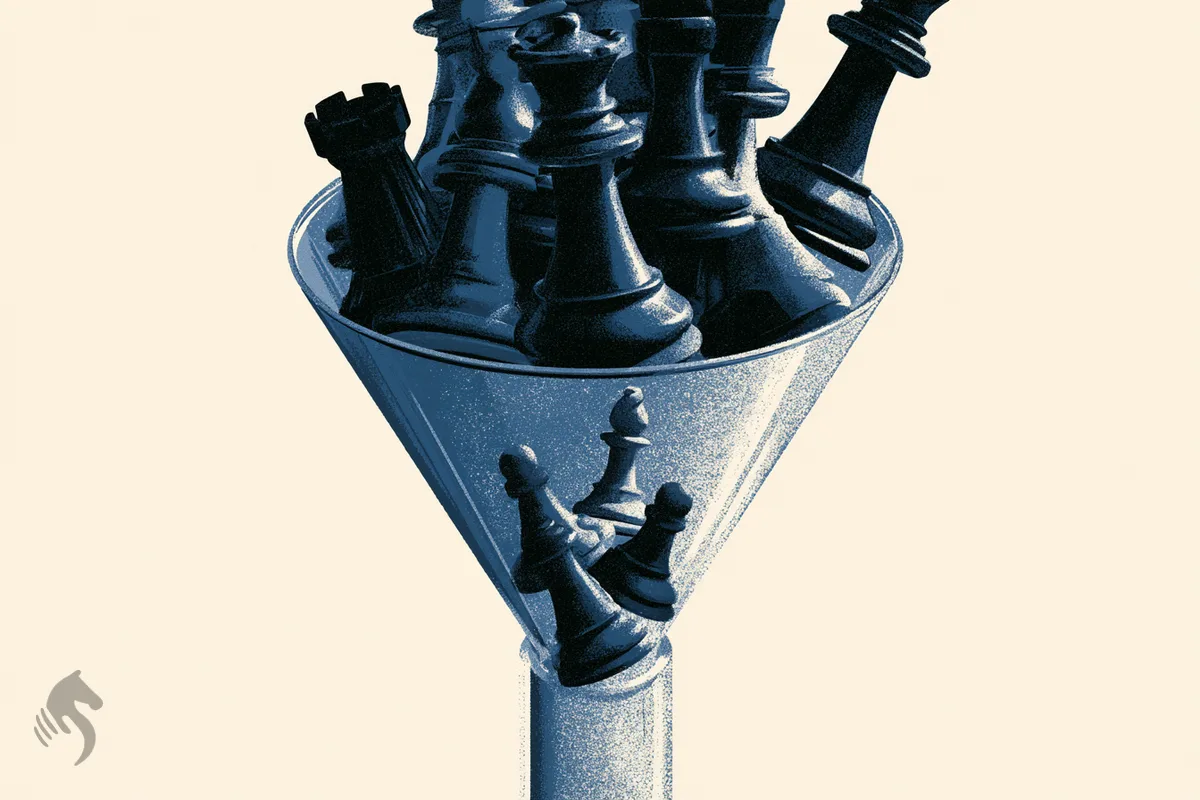
Neil Charness (Florida State University) showed that grandmasters build a "stripped-down" representation: pieces important for the current variation are maintained with precision, the rest is processed more schematically and can even be recalled inaccurately if questioned about peripheral pieces mid-calculation.
This isn't a limitation: it's an efficient adaptation. Maintaining a complete, precise representation of all 32 pieces would consume cognitive resources uselessly. The expert brain makes intelligent selection based on relevance.
Spatial Chunks
Gobet and Simon's chunking theory also applies to the spatial dimension. Experts don't see 16 black pieces separately: they see "structures", "queenside castle with intact pawns," "Carlsbad structure with double open file," "R+P vs R endgame." These spatial chunks are recognized as blocks, not reconstructed piece by piece.
This explains why grandmasters can analyze a position blindfolded: they don't need to memorize each piece separately. They memorize meaningful configurations, each having internal logic they can reconstruct.
Brain Activation: The Parietal Cortex in Action
fMRI studies on spatial cognition consistently show involvement of the superior parietal cortex, the pre-motor cortex, and the visuospatial working memory space.
Giorgio Cattaneo and colleagues (2009) studied the brain correlates of chess variation calculation. Their results show bilateral activation of the superior parietal cortex, the same region activated during classic mental rotation tasks.
This result is important: it suggests that chess variation calculation (visualizing pieces moving) uses the same circuits as general spatial tasks. Chess practice therefore trains these circuits in a targeted way.
Blindfold Chess: The Ultimate Exercise
Blindfold chess, playing without seeing the board, dictating moves orally or by notation, represents the most direct exercise of spatial visualization in chess.
Historically, blindfold feats have fascinated audiences: Paul Morphy played 8 simultaneous blindfold games in 1858. The current record, set by Timur Gareyev in 2016, is 48 simultaneous blindfold games.
But blindfold games aren't reserved for grandmasters. They're a scalable training tool:
Beginner/intermediate level: Play the first 5-10 moves of a known opening without looking at the board, then check the position. An exercise in anchoring theoretical structures in spatial memory.
Intermediate level: Solve simple tactical problems without seeing the board (the problem is described verbally or in notation). Forces spatial reconstruction from notation.
Advanced level: Play complete blindfold games against a weaker opponent. The level reduction compensates for the additional difficulty of visualization.
Spatial Vision and Mathematics: The Link
A benefit often mentioned for school chess programs is improved math performance. Studies show this benefit is more marked for spatial mathematics (geometry, trigonometry, certain aspects of physics) than for arithmetic or abstract algebra.
This result makes sense: geometry and physics require exactly the same operations of mental rotation, spatial decomposition, and transformation as chess variation calculation. The transfer is real because both domains share the same brain circuits.
Practical Exercises to Develop Visualization
1. Mental maps of the board. Without a board in front of you, mentally visualize square h8. Then c4. Then mentally trace the path of a Bishop from a1 to h8. What color is square e5? These simple exercises train the cognitive map of the chessboard.
2. Short blindfold variations. Take a simple tactical position. Close your eyes. Visualize the first attacking move, then the defensive response, then the next move. Open your eyes and check. Progressively increase depth.
3. Notation dictation. Have a partner read you the first 15-20 moves of a famous game (algebraic notation), try to visualize the final position, then compare with the real board.
4. Engine-free analysis. Analyzing a game without an engine first, noting your variations on paper, forces visualization of positions that never physically existed. It's a spatial visualization exercise disguised as analysis.
Sources
- Tejada-Gallardo, C., et al. (2021). Effects on spatial reasoning. Educational Psychology Review, 33, 1689-1720.
- Cattaneo, Z., Postma, A., & Vecchi, T. (2006). Gender differences for spatial memory. British Journal of Psychology, 97(3), 339-352.
- Charness, N., et al. (2001). The perceptual aspect of skilled performance in chess. Memory & Cognition, 29(8), 1146-1152.
- Gobet, F., & Simon, H. A. (1996). Templates in chess memory. Cognitive Psychology, 31(1), 1-40.
- Ferguson, R. (1995). Chess in education research summary. Paper presented at the Chess in Education, A Wise Move Conference.
Key Takeaways
- Chess practice improves spatial reasoning with a significant effect (ES = 0.54, Tejada-Gallardo 2021, 17 studies)
- Variation calculation activates the same regions as mental rotation tasks (superior parietal cortex)
- GM visualization is not photographic but schematic: a representation of critical pieces, not a complete snapshot
- Blindfold chess is the most direct exercise of spatial visualization, accessible in tiers from intermediate level
- Children aged 5-10 show the most marked improvements: optimal developmental window for visuospatial processing


Comments