
You have just lost a game. You open your library, revisit the variation that caused you trouble, and spend forty minutes memorising moves you may never play again. It feels useful. It feels like work.
Before starting again, ask yourself one question: was the opening really what cost you the game?
The 40-40-20 rule proposes spending 40% of your time on tactics, 40% on endgames and 20% on openings. It is a training heuristic, not a scientific rule. I do not have a primary source establishing its origin or demonstrating that these proportions are optimal. You can use it as a starting point, then adapt it.
What research can tell us
Chase and Simon (1973) study position reconstruction in three players of different strengths. Their analysis highlights the organisation of pieces into familiar groups in experienced players’ memory. It does not determine how many minutes you should spend on openings or endgames.
Ericsson, Krampe and Tesch-Römer (1993) examine deliberate practice: demanding activities designed to improve performance. Their work supports the value of targeted training; it validates neither the 40-40-20 proportions nor the promise that one attentive exercise is worth exactly ten rushed ones.
You can retain a practical question: which specific difficulty are you working on, and how will you check whether you handle it better?
A one-hour session
Here is the arithmetic application of the formula, as an example:
| Work | Time | Example |
|---|---|---|
| Tactics | 24 minutes | Solve a position, then explain the opponent’s defence |
| Endgames | 24 minutes | Play a basic endgame from both sides |
| Openings | 12 minutes | Review the first moment you hesitated in a game |
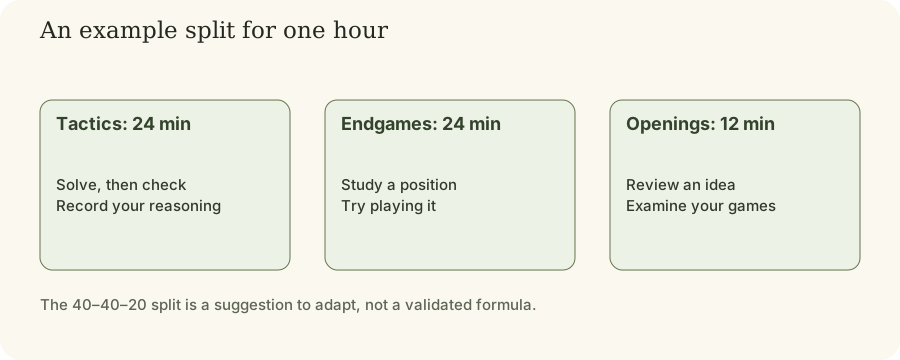
This session is a suggestion. If you have less time, you can spread the subjects across the week rather than tackle all of them every day.
Openings: no magic threshold
Thresholds of 1600, 1800 or 2000 Elo are not established here by a study. You do not need to wait for a particular rating to understand development, king safety or the plans associated with a pawn structure.
Base your decision to explore a variation more deeply on your games. Do you regularly leave the opening without a plan? Do you repeat a mistake you do not understand? Targeted review may then deserve a place. If the position remains playable and you lose a piece later, memorising ten more moves does not directly address that mistake.
Endgames: learning an identifiable technique
Choose a concrete objective: mating with a rook, using the opposition or stopping a passed pawn. Replay the position to check that you can carry out the technique without following the solution.
Half a point saved in an endgame counts just as much towards your score as elsewhere. That does not prove that all endgames deserve exactly 40% of your time, or that they are always more decisive than the opening.
Tactics: explain before moving on
In an exercise, look for the opponent’s best defence and explain why other candidate moves fail. After a mistake, identify what you missed: an undefended piece, an open line, a defensive resource?
Familiarity can create an impression of mastery. To test it, try solving the position without looking at the answer, then return to it later. This way of working does not constitute a measure of your potential.
Making room for your own games
The formula leaves out an essential part of reviewing your own progress: examining what you actually played. You can reserve a slot for that analysis and reduce the other three allocations accordingly. No fourth percentage is imposed here.
Note a recurring difficulty, choose an exercise that addresses it, and reassess your choice after several games. If your results fluctuate, also consider the time control and your opponents: an Elo change does not measure the quality of the programme in isolation.
To organise recovery between sessions, see the benefits of breaks. For your relationship with results, see the psychology of the chess player.


Comments