
Philidor played three simultaneous blindfold games. His 18th-century audience was stunned: how could a man hold three chessboards in his head simultaneously?
Today, grandmasters play twenty, thirty blindfold games without notable effort. Marc Lang played 46 simultaneous blindfold games in 2011, winning 19, drawing 13, and losing only 4.
The question is not "is it possible?" The question is "how?"
What Visualization Is Not
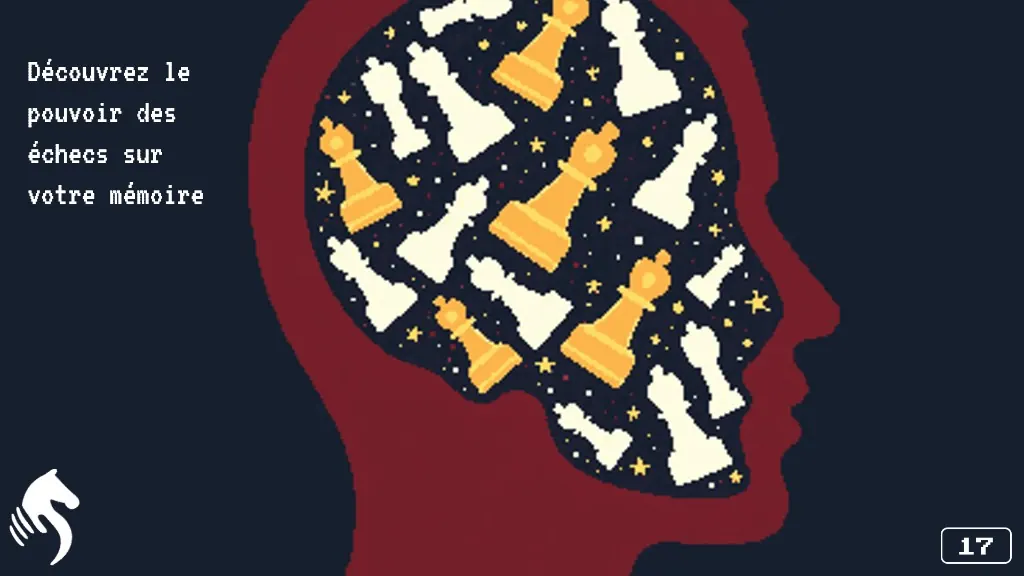
The most common error is imagining that chess players "see" a mental chessboard, a photographic image of the real board, floating in their mind.
That's not what neuroscience shows.
Brain imaging studies of players practicing blindfold chess show activation of parietal and frontal regions, regions associated with spatial working memory, spatial relationship processing, and long-term memory, rather than primary visual cortex regions that would process a literal mental image.
What chess players "see" is not an image. It's a structure of relationships.
Chunk Theory: Chase and Simon (1973)
The foundational study by William Chase and Herbert Simon remains one of the most cited in cognitive psychology. The experiment was simple and revealing.
Two groups: chess experts (master level) and novices. They were shown a position from a real game for 5 seconds, about twenty pieces on the board. Then they were asked to reconstruct the position from memory.
Results: experts correctly replaced an average of 92% of the pieces. Novices, about 20%.
Predictable conclusion: experts have better memory, right?
Second phase. They were shown a random position: the same pieces, but placed without game logic, as if drawn at random. Same exposure time, same reconstruction task.
This time, both groups were comparable: about 30% correct reconstruction each.
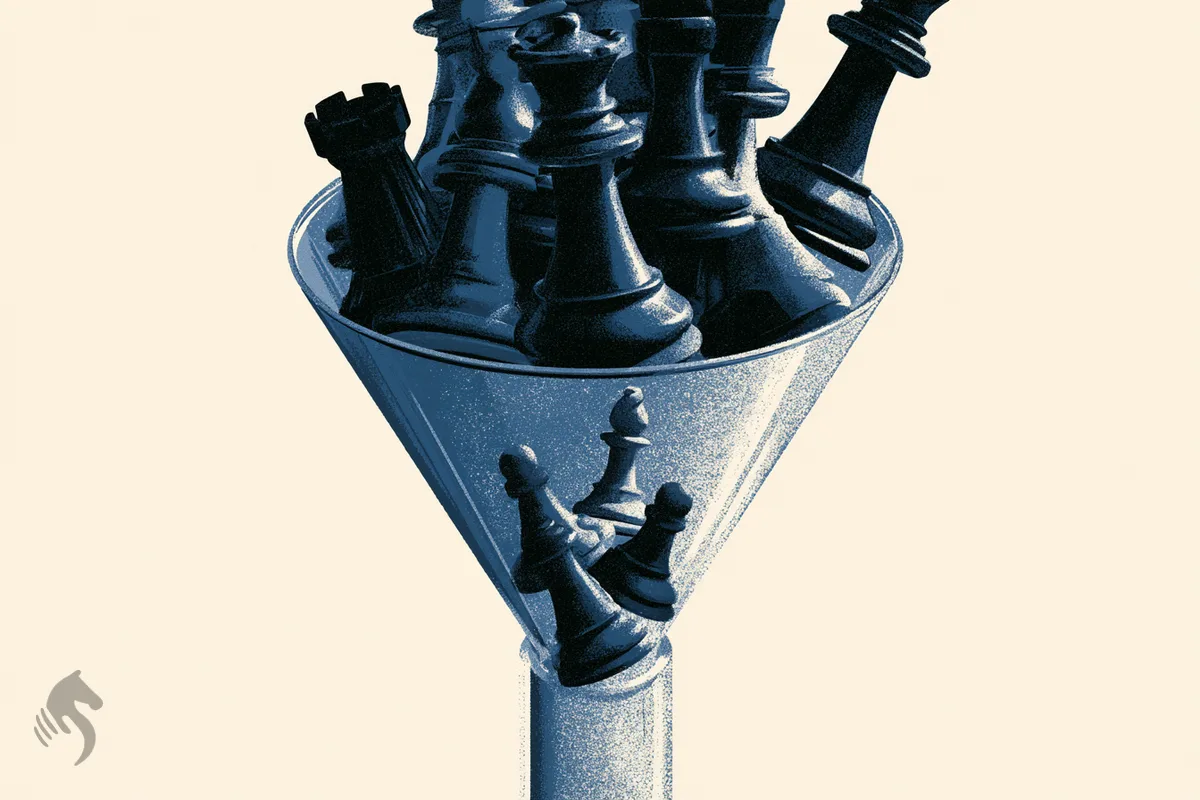
The conclusion is radical: chess experts don't have superior visual memory. They have a pattern library, thousands of real-game configurations stored in long-term memory. When they see a real game position, they decompose it into familiar patterns ("chunks"), each memorized as a single unit. When the position is random, these patterns don't apply and the advantage disappears.
A master-level player has approximately 50,000 chess chunks stored in long-term memory, Simon's own estimate. A grandmaster would have more. A beginner has a few dozen.
How Chunks Work in Visualization
Take a common formation: the kingside castle, with the king on g1, the rook on f1, a bishop on e2, and pawns on g2, f2, h2. For an experienced player, this is a single chunk ("classic short castle") memorized as one unit. They don't need to remember seven separate elements, only one.
When this player calculates a variation blindfold, they manipulate these chunks as blocks. "If I push the h-pawn, the classic short castle becomes a weakened short castle, with such-and-such typical vulnerability." These relationships between chunks are themselves memorized: the library isn't a flat list of images, it's a network of linked structures.
Blindfold Chess as the Limit Case
Blindfold chess (blindfold chess) pushes these mechanisms to their extreme. Without a visible board, the player must maintain the complete position representation in working memory, leaning heavily on long-term memory to store chunks and keeping only recent modifications in working memory.
Brain imaging of blindfold players shows particularly strong activation of the intraparietal sulcus (spatial processing) and the hippocampus (episodic and spatial memory), the same regions that activate when mentally navigating a familiar environment. When playing blindfold, the player mentally navigates a space of positions, like an architect mentally walking through a building they know well.
Studies comparing normal and blindfold play in the same player show that performance decreases in blindfold (typically by 100-200 Elo points) but that move quality is similar for simple moves. Blindfold errors occur primarily in complex positions with many active pieces, precisely the cases where working memory load is maximal.
Training Visualization
The good news: visualization capacity can be trained, and progress is measurable.
The recommended progression method follows a logic of progressive loading:
Level 1: Calculate without touching. In a normal game, force yourself to calculate every variation mentally to completion before touching a piece. Many players habituate their brain to adjust visualization by physically moving pieces. Removing this recourse forces pure visualization.
Level 2: Tactical problems with eyes closed. Read a tactical problem, look at the position for 30 seconds, then close your eyes and calculate the solution. Check by opening your eyes. Start with simple problems (mate in 1-2), progress to longer combinations.
Level 3: Blindfold endgames. Play simple endgames (King + Rook vs King, King + Pawn vs King) against an opponent or engine, eyes closed, giving moves verbally. These positions have few pieces, the memory load is manageable.
Level 4: Short blindfold games. Quick games (5 minutes), eyes closed, against a willing opponent who plays at normal pace.
Studies show that 3-6 months of regular training with these exercises (30-45 minutes per week) measurably improve visualization, particularly on tests of position reconstruction after brief viewing.
Sources
- Chase, W. G., & Simon, H. A. (1973). Perception in chess. Cognitive Psychology, 4(1), 55-81.
- Gobet, F., & Simon, H. A. (1996). Templates in chess memory. Cognitive Psychology, 31(1), 1-40.
- Charness, N., et al. (2001). The perceptual aspect of skilled performance in chess. Memory & Cognition, 29(8), 1146-1152.
Key Takeaways
- Chess visualization is not a "mental image" of the board: experts encode positions in chunks (linked piece groups) stored in long-term memory
- Blindfold chess activates the same brain regions as normal play, plus spatial working memory regions (intraparietal sulcus, hippocampus)
- The Chase and Simon (1973) study is foundational: experts don't memorize random positions better than novices, their advantage is specific to real game positions
- A master has approximately 50,000 chunks stored in long-term memory
- Visualization exercises (calculating without touching, blindfold problems, blindfold endgames) improve measurably in 3-6 months of regular training
Comments