
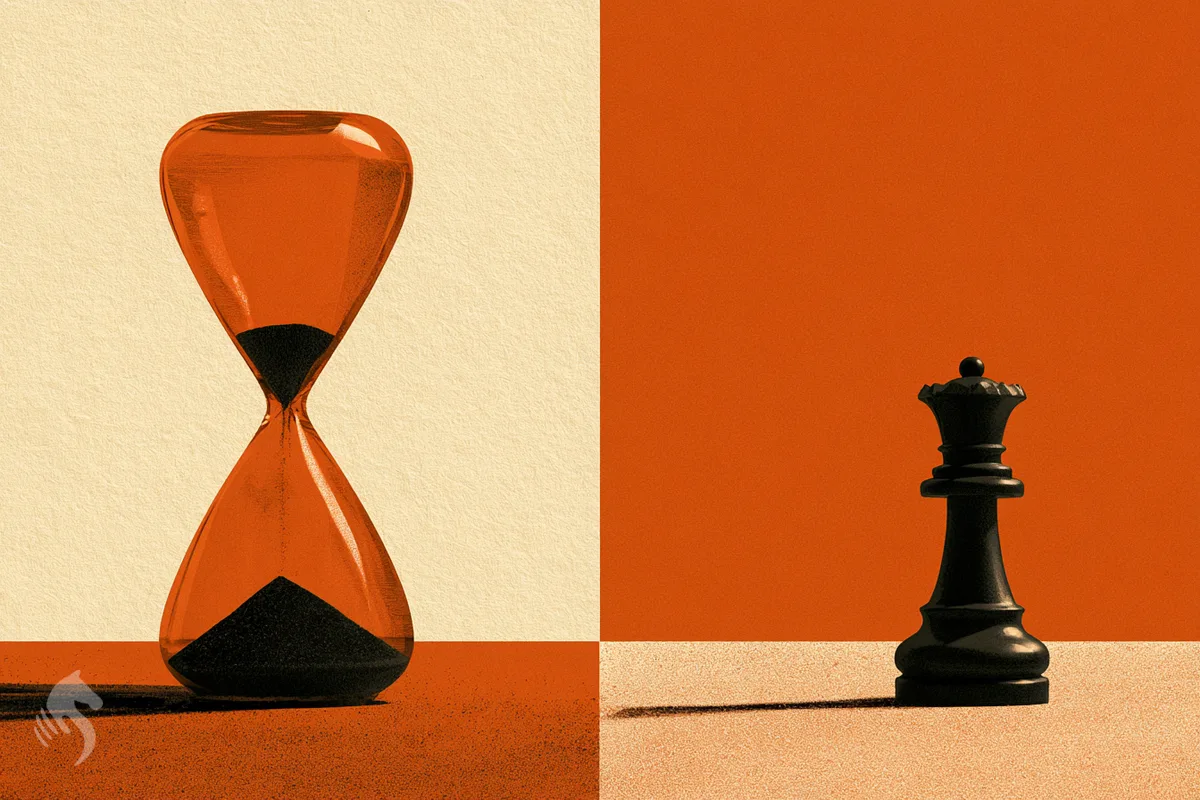
Move 23. You reach for the bishop. Put it back. Touch the knight. Put it back. Replay the position in your head from move 14, as if retracing the path would reveal the move you can't find. The clock eats 4 minutes during this routine.
It's exactly this routine, not the move you'll eventually play, that decides the game.
You're not calculating. You're fleeing. And it's the same thing you do when you open a tenth browser tab instead of tackling the project that's been waiting for three days.
You Don't Procrastinate Out of Laziness: You're Fleeing an Emotion
Contemporary psychology has inverted its model in the last twenty years. Procrastination is no longer understood as a discipline or time management defect. It's an emotional regulation mechanism.
When a task generates anxiety, doubt, fear of failure, or simply boredom, your brain seeks to neutralize the immediate discomfort. The fastest way: stop exposing yourself to it. You open another tab. You check your email. You make coffee you didn't ask for. Relief.
Except the task comes back. Later. With increased anxiety because the deadline has moved closer. Which makes the next avoidance even more probable. This is what psychologist B.F. Skinner called operant conditioning: a behavior that produces immediate relief reinforces itself, even when it worsens the long-term problem.
This is not character weakness. It's a predictable brain mechanism, studied notably by Fuschia Sirois (Sheffield) and Timothy Pychyl (Carleton), who spent twenty years dismantling it experimentally.
Why the Clock Succeeds Where Your Deadlines Fail
The chessboard has something your life almost never has: a clock that doesn't negotiate.
It doesn't stop because the position is complicated. It doesn't account for the fact that you didn't sleep well. It doesn't let you "come back to it tomorrow." It ticks. And when the flag falls, you lose, even if your next move would have been brilliant.
In real life, your deadline is in a week. In a month. Avoidance costs nothing right now. Behavioral psychologists call this hyperbolic discounting: your brain prefers €10 now to €15 in a month. Even when it's mathematically stupid. Future costs carry less psychological weight than immediate benefits. That's why "I'll start tomorrow" is so convincing in the moment.
The clock destroys this temporal gap. Inaction has a price right now, in seconds ticking away. Playing an imperfect move on time almost always beats not playing at all.
Overthinking: Procrastination Dressed as Diligence
Chess instructors have a word for it: overthinking. You calculate a line. You validate it. You recalculate to be sure. You start over. You hesitate again.
This is exactly procrastination, just dressed up as diligence.
Botvinnik, six-time world champion, told his students something like: "If you haven't found a clearly better move after twenty minutes, you won't find one in thirty." Beyond a threshold, additional time doesn't produce better calculation. It produces fatigue, anxiety, and less time for subsequent moves.
The key distinction players learn (often at the cost of a fallen flag): good enough to act ≠ perfect enough to have no regrets. The first exists. The second exists nowhere, not on 64 squares, not on a work project, not in a message to send.
The Measured Effect on Regular Players
Psychologists measure a variable they call ambiguity tolerance: your capacity to act when information is incomplete, without freezing up.
Several studies (Sala & Gobet 2017 meta-analysis on cognitive transfer from chess) show that regular chess players display on average higher ambiguity tolerance than non-players of the same education level, including on tasks unrelated to chess. The effect is moderate: not spectacular, not universal, but replicable.
The proposed mechanism is simple: 50 games = 1,500 decisions under incomplete information, each followed by an immediate consequence (the opponent's response reveals whether it was good). This decision → consequence → adjustment loop, repeated thousands of times, rewires tolerance.
One condition, however: the transfer isn't automatic. It requires a conscious bridge. "On the board, I played despite doubt and it worked, where in my life can I do that today?" Without this explicit translation, the effect stays local to the game.
The "Touch-Move" Rule Disables the Regret Trap
In chess, if you intentionally touch a piece, you must move it. And once placed, it's placed. No takebacks, no undo, no "I miscalculated."
This mundane rule has a massive psychological effect: it prohibits regret as a strategy.
In real life, many procrastinators are stuck because they imagine their choices as infinitely reversible (therefore infinitely optimizable, therefore infinitely postponable). If I can always go back, I might as well wait until I'm sure.
Chess players live the opposite. They know every move is final. And yet, watch them: they don't spend their time regretting. They adapt to the new position. The previous move is dead. The only living question is: what do I do now?
That's the mindset to steal. Not the illusion of having chosen well. The ability to turn the page without rereading it.
Sources
- Sirois, F., & Pychyl, T. A. (2013). Procrastination and the priority of short-term mood regulation. Social and Personality Psychology Compass, 7(2), 115-127.
- Sala, G., & Gobet, F. (2017). Does far transfer exist? Current Directions in Psychological Science, 26(6), 515-520.
- Steel, P. (2007). The nature of procrastination. Psychological Bulletin, 133(1), 65-94.
Key Takeaways
- Procrastinating = neutralizing an uncomfortable emotion. Not a willpower defect.
- The chess clock succeeds because it makes inaction immediately costly. Replicate it with a timer or a non-negotiable appointment.
- Overthinking and procrastination have the same structure: delaying action by seeking certainty that won't exist.
- 50 games = 1,500 decisions under uncertainty. Measurable but moderate effect on ambiguity tolerance off the board, provided you consciously bridge the two.
- "Touch-move" trains you to decouple decision from regret. That's what to steal from chess for your life.
Comments