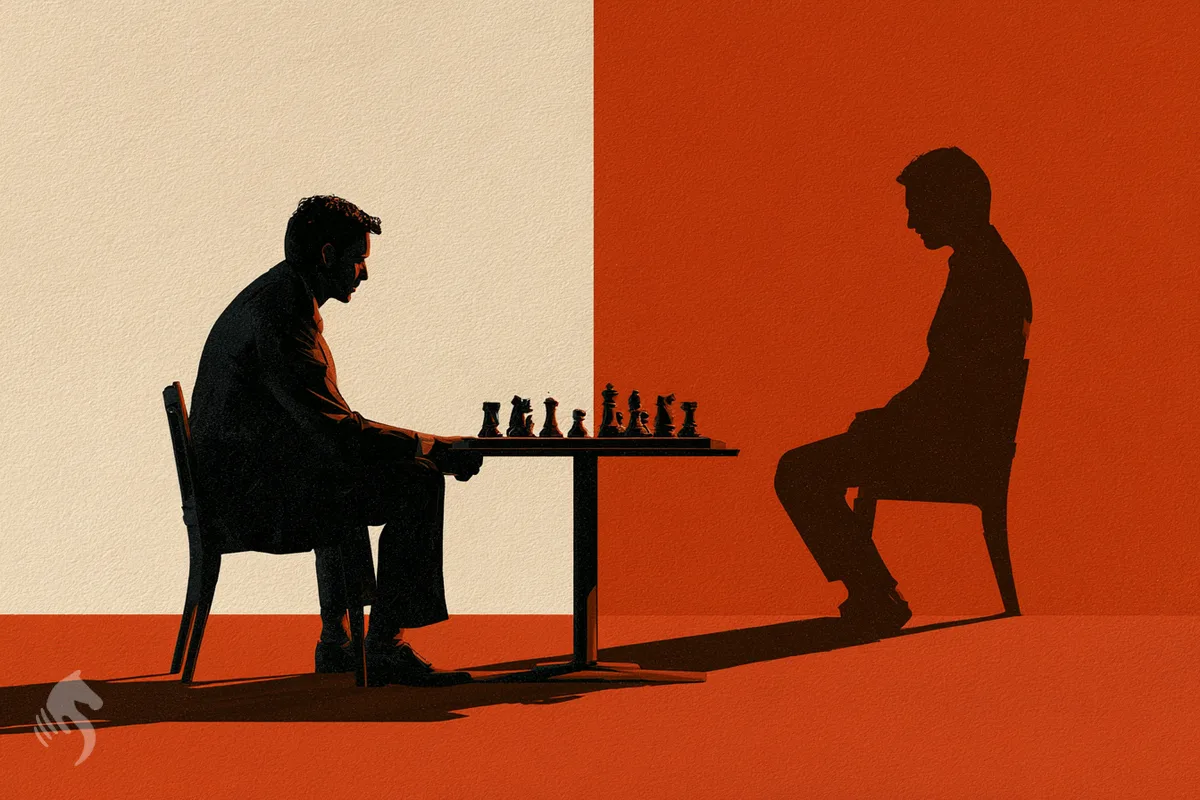
You're better. Clearly better. You have an extra pawn and a healthy structure, and you have twenty minutes to his twelve.
He offers a draw.
And for the next forty seconds, you stop calculating. You wonder what he saw. A player doesn't offer a draw for no reason. Maybe there's a resource you haven't found. You go back over the position with a different eye, you start looking for what could go wrong.
He saw nothing. He's lost and he knows it. But he's just bought forty seconds of your doubt for the price of a sentence.
Where the Boundary Runs
We need to be precise from the outset, because the subject is slippery and plenty of perfectly legitimate things look like manipulation.
Psychological play has always been part of chess and is entirely honourable. Choosing a closed variation against a player who only likes open positions is psychological play. Avoiding a theoretical line because you know your opponent has prepared it is too. So is speeding up your rhythm when the other player is short of time. Emanuel Lasker made an art of it.
What all these examples have in common: everything happens on the board. The opponent is put in difficulty by moves. He has every means of responding, and if he plays better, he wins.
Emotional manipulation begins when the action targets your opponent's internal state by means external to the position. It's no longer his play under attack, it's his capacity to play.
Two notes on the scope of this article. It deals only with what operates during the game. What happens afterwards, when someone rewrites what took place, is a different mechanism, described in our article on gaslighting in chess. And this isn't about cheating: nobody is consulting an engine here, which is an entirely different subject, covered in cheating in chess.
The Textbook Case: Baguio, 1978
If you want to see how far the technique can go, there's an example nothing has ever surpassed.
World championship 1978, Baguio, in the Philippines. Anatoly Karpov, reigning champion and official representative of the USSR, against Viktor Korchnoi, who had defected from the Soviet Union two years earlier and played under no flag. The political context was explosive before the first move.
What anyone remembers is almost never a game.
Korchnoi accused Vladimir Zukhar, a Soviet parapsychologist installed in the front rows of the hall, of trying to destabilize him mentally by staring at him during play. He demanded the man be moved. The Karpov camp refused. The question occupied the organizers for weeks.
The Karpov camp, for its part, protested against Korchnoi's mirrored glasses, which made it impossible to see his eyes.
And then there was the yoghurt. During the second game, Karpov was brought a blueberry yoghurt. The Korchnoi camp filed a written protest: the colour and timing of the delivery might constitute a coded message.
Karpov eventually won 6 to 5, at the end of a match that remains the historical summit of the genre.
What the Affair Actually Demonstrates
Look closely at what happened, because the lesson isn't the one people assume.
Zukhar had no power. Parapsychology doesn't work. A man sitting in a hall looking at a player cannot alter his calculation.
And yet the effect was considerable. Korchnoi devoted an enormous share of his energy to the affair: protests, negotiations, monitoring the hall, attention diverted in every game.
The effect wasn't produced by Zukhar. It was produced by Korchnoi's conviction. This is exactly the nocebo mechanism, described in our article on the placebo effect in chess: negative expectation acts where positive expectation doesn't.
Which gives us the general principle of the whole subject. Manipulation never works directly. It works by getting you to process it.
The Real Repertoire
Baguio is spectacular, but your Tuesday night club works differently. Here's what actually gets practised there, from most frequent to rarest.
The Draw Offer as a Weapon
Tool number one, because it's free, permitted and effective.
Three misuses. In a losing position, it manufactures false information: your position may be worse than you think. In an equal but tense position, it tests your fatigue and offers you an honourable exit at the moment you're most tempted. Repeated, it becomes purely consumptive: every offer forces a decision, and every decision costs time and attention.
The rules regulate abusively repeated offers, precisely because the problem has been known for a long time.
Tempo as a Message
This one is nearly invisible, and it's everywhere.
You play a move on move ten of an opening. He replies in two seconds. The message is explicit without being spoken: I know this position, this is theory to me, you're already on prepared ground.
Often it's false. He simply moved fast. But you've received the information, and you're going to spend the next three moves wondering how deep his preparation runs, instead of looking at the board.
The reverse variant exists too: thinking for a very long time over an obvious move, to make you believe the position contains something you haven't seen.
Body Language
The sigh when you play your move. The brief smile. Standing up immediately after moving, as though what follows were of no interest. The pointed stare.
Each of these gestures is empty in itself and uninterpretable. That's exactly what makes them effective: they transmit no information, but they trigger a search for information. You're going to try to read them, and that reading is calculation time gone.
The Online Comment
Platform chat has industrialized the thing. "nice blunder," the post-defeat message, the immediate rematch request when you've just lost three games.
The most effective version isn't the insult, which is easy to ignore, but false kindness: "don't worry, it happens," "you play well for your level." You can't call it out without looking thin-skinned.
Ostentatious Preparation
Arriving at the table with a book on your opening clearly visible. Consulting notes just before the round, within sight. Nothing has been played, nothing has been said, and the information has landed.
Why It Works
None of these techniques makes a position better. None finds a move. So why are they effective?
Because they don't attack your calculation. They attack the resource you calculate with.
A game of chess consumes a limited quantity of attention, and that limit is narrow. Every non-chess thought takes a share of it: "why did he sigh," "has he prepared this," "is he laughing at me." Those thoughts last only a few seconds, but they arrive at the worst moments, the ones where the position is critical and the opponent has just acted.
It's also why defences based on willpower don't work. Deciding to ignore a behaviour requires noticing it first, therefore processing it. Ignoring it already costs something. The only effective defence is to make the decision independent of the behaviour, which requires having made it beforehand.
Five Defences
Decide before, not during. Set your rule on draw offers before you sit down. For example: I never answer before evaluating the position for three minutes, whatever my conviction. A rule decided cold doesn't get negotiated hot, and above all it no longer depends on who offers, or when, or how.
Treat your opponent's tempo as noise. The speed at which he plays isn't data about the position. It's data about him. The only reliable source of information about the position is the position.
Make waiting time useful time. Emptiness is what makes you vulnerable. While your opponent thinks, have a fixed task: inventory your badly placed pieces, look for his best plan, check the weak squares. Occupied attention can't be captured.
Cut the channel when one exists. Online, disable chat. That isn't an admission of fragility, it's resource management. No message received during a game will help you play better.
Use the official channels, without making it a cause. If a behaviour crosses the line, the arbiter exists and the rules cover the case. Reporting it and returning to the game costs far less than managing it yourself for two hours. That's precisely Korchnoi's lesson: he tried to handle the problem himself, and the handling cost him more than the problem.
What to Take Away
Emotional manipulation in chess isn't trying to make you play a bad move. It's trying to occupy the space you need in order to find the good one. It's an attack on the resource, not on the position, and that's why it's so economical: a four-word sentence can cost you a minute of calculation at a critical moment.
Its mechanism requires your participation. Zukhar had no power, and neither did Tal's stare. What worked, in both cases, was the target's conviction. Manipulation is a proposal: it only takes effect if you process it.
Hence the only defence that holds. Not being mentally stronger, which means nothing three hours into a game, but having decided in advance what won't depend on him.
After reading: write your rule on draw offers. One sentence, applicable without thinking, valid whatever the position. You've just removed a tool from your opponent's repertoire.
This article is part of a series on psychology applied to chess. See also gaslighting in chess, which deals with what happens after the game, and defense mechanisms in chess.
Sources
- Fédération Internationale des Échecs. Laws of Chess, article 11: conduct of the players.
- Korchnoi, V. (1981). Chess Is My Life. Arco.
- Karpov, A., & Roshal, A. (1980). Karpov on Karpov. Atheneum.
- Beedie, C. J., & Foad, A. J. (2009). The placebo effect in sports performance: A brief review. Sports Medicine, 39(4), 313-329.
Comments