The 40-40-20 Rule: How to Really Structure Your Chess Training
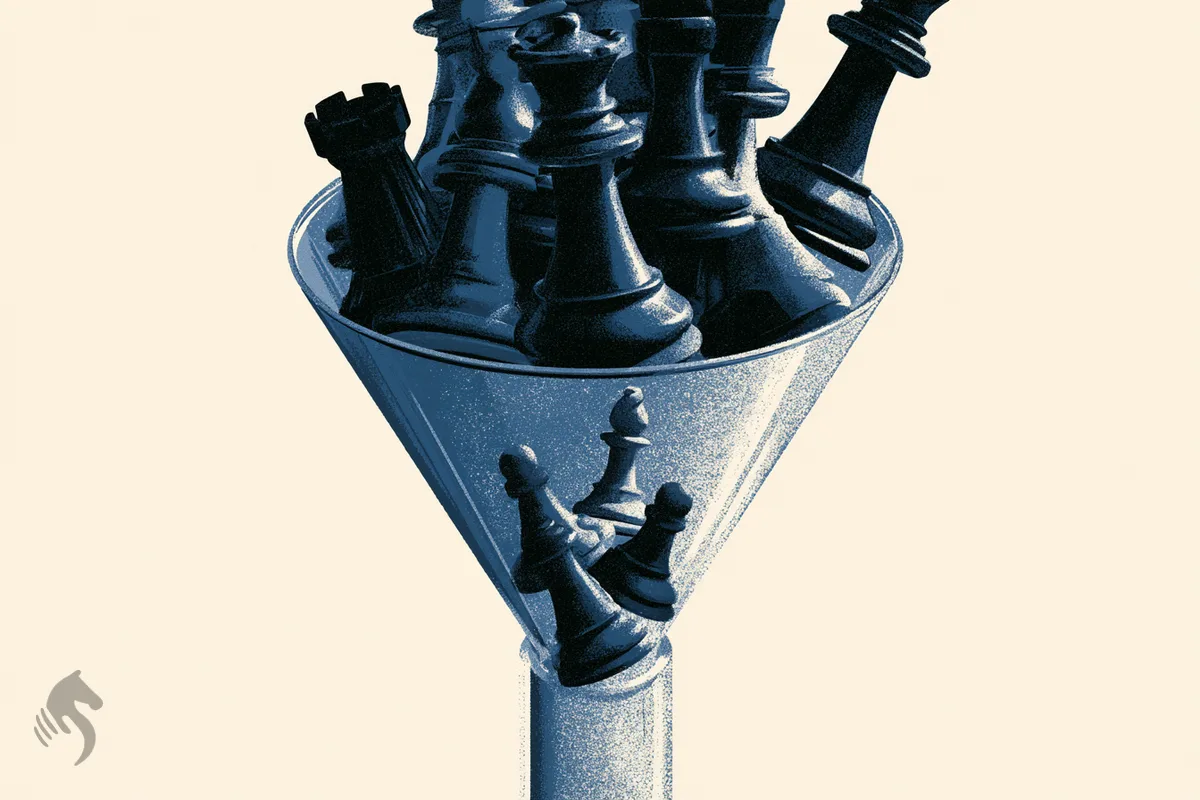
Most players spend 80% of their time on openings. The 40-40-20 rule says the opposite: 40% tactics, 40% endgames, 20% openings. Why? And does it actually work?
Game science, competitive mindset, chess and society, personal analyses.
Most players spend 80% of their time on openings. The 40-40-20 rule says the opposite: 40% tactics, 40% endgames, 20% openings. Why? And does it actually work?
Chess is the founding ground of game theory. Minimax, Nash equilibrium, perfect information: a mathematical breakdown of what is really happening when you play.
The game tree explodes, Shannon's number is staggering, yet an engine corrects you in seconds. Is chess really 'unsolvable'? Here's what maths, computer science and AI actually do under the hood.
Chess isn't just played on the board. It's played first in your head, before your hand ever touches a piece. A psychological portrait of a player facing themselves.
A grandmaster isn't a born genius: they have a trained brain. Structural MRI, functional connectivity, chronnectome, executive functions: here is what neuroscience research actually measures about chess players' brains.
40 women among 1,700 Grandmasters. The gap isn't biological: it's mathematical, historical and psychological. What the data really says, and why the 'female brain' argument doesn't hold.
It's 3am. You promised yourself it was the last game, but you're launching another one. Can you really be addicted to chess? A breakdown of a silent addiction.
Playing chess makes you good at maths? The answer isn't what you'd expect - and it radically changes what you should do with a chessboard.
For a brain that struggles with social ambiguity, the chessboard is one of the few spaces where rules truly hold. What research actually says about autism and chess, without romanticism or oversimplification.
No articles match your search on this page.