In 1913, at the fifth International Congress of Mathematicians in Cambridge, German mathematician Ernst Zermelo presented a result that would change how mathematicians, and later computer scientists, think about strategy games. His theorem is short. Its demonstration is elegant. And its implications for chess are both reassuring and dizzying.
Ernst Zermelo and Set Theory
Before talking about chess, you need to understand who Zermelo was. He's mainly known for his fundamental contributions to set theory, in particular the axiom of choice and the Zermelo-Fraenkel axioms that still constitute today's standard foundations of mathematics.
In 1913, his interest in chess wasn't insignificant. Mathematicians of the era sought to formalize logical reasoning in systems as rigorous as possible. Perfect strategy games represented ideal terrain.
Zermelo's Theorem: Statement and Demonstration
Zermelo's theorem applies to a class of games including chess: two-player games with direct confrontation, perfect information, no chance, where both players play alternately, and which always end in a finite number of moves.
Statement: In any game of this type, one of three situations is necessarily true: player 1 has a winning strategy, or player 2 has a winning strategy, or both players can force a draw.
The demonstration uses backward induction on the maximum possible game length. It's exactly the same mechanism as the modern minimax version, 35 years apart.
Imagine an endgame position reached. Each terminal position is either a White win, Black win, or draw. Now go back one move. If it's White's turn, they can choose among accessible terminal positions the one most favorable to them. By recursively going back from all terminal positions to the initial position, each position in the game tree receives a defined value.
The value of the initial position is therefore determined. The first player to move either has a strategy to force victory, or both players can force a draw, or the second player has a strategy to force victory.
A Refined Demonstration Afterward
Historical detail often forgotten: Zermelo's original 1913 text contains a non-trivial subtlety about finiteness. Zermelo implicitly assumes every game ends in a finite number of moves but doesn't correctly handle the case where the losing party can indefinitely delay checkmate. Dénes König (1927) then László Kalmár (1928) completed the proof with what's now called König's lemma. In chess, this detail is settled practically by the 50-move rule and threefold repetition rule.
Why It's Paradoxical
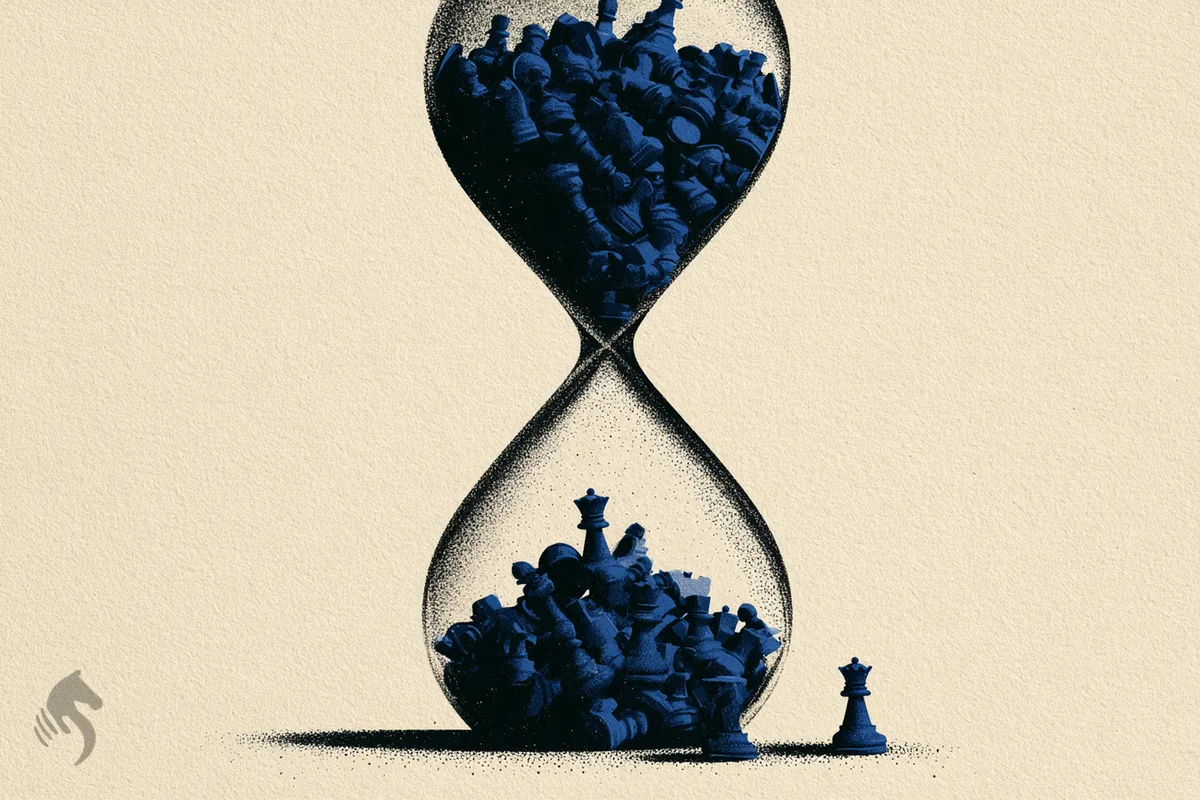
Zermelo's paradox isn't logical. It's a practical paradox. The theorem guarantees the answer exists and is unique. But it doesn't tell you what it is. And especially, it doesn't tell you how to find it.
To find the real value of chess's initial position, you'd need to traverse the entire game tree. This tree contains about $10^{120}$ leaves according to Shannon's estimate. For reference, the age of the universe is about $4 \times 10^{17}$ seconds, and the number of atoms in the observable universe is about $10^{80}$.
The complete resolution of chess by exhaustive exploration is physically impossible with any conceivable technology.
The Unknown Truth of Chess
The great question Zermelo's theorem leaves open: what is the value of chess under perfect play?
The majority of grandmasters and theorists think the answer is a draw. The empirical argument is strong: at the highest level, draws are very frequent, and the initial position is considered slightly favorable to White but not enough to force victory against optimal defense.
But this is just intuition based on observation of human play. It's not a proof. It's mathematically possible that White has a forced win hidden in depths no human has ever explored.
Resolved Endgames: A Window on the Truth
If solving chess in its entirety is impossible, there's a domain where complete resolution has been accomplished: endgames with few pieces.
Endgame tablebases developed by Ken Thompson then Marc Bourzutschky and others have solved all endgames up to seven pieces on the board. This monumental work has revealed surprising results.
The Rook-Queen vs Rook-Queen endgame, for example, had long been considered drawn. Tablebases revealed that in certain configurations, one side can force victory in... 517 moves. No human, even the world's best Grandmaster, could find this path by their own reasoning.
The DTM/DTZ Jump: Two Truths for the Same Position
Tablebases distinguish two measures of "forced win": DTM (Distance to Mate) and DTZ (Distance to Zero, distance to the next pawn move or capture resetting the 50-move counter). The same winning endgame can have DTM = 517 and DTZ = 7. This duality illustrates something deep about Zermelo: the mathematical truth of a position depends on the chosen "winning" criterion.
The Structural Imperfection of the Human Player
Zermelo's paradox reveals something fundamental about the human player's condition. They play a game whose "perfection" is mathematically defined but physically inaccessible.
A human player, even the world's best, plays an approximation of the optimal strategy. Their playing level is determined by the quality of this approximation.
Magnus Carlsen, considered by many the best player in history, still commits errors. Stockfish, the best chess engine currently, also commits errors relative to theoretical perfect play.
The difference between Carlsen and Stockfish isn't qualitative (one plays perfectly and the other doesn't), it's quantitative (one is a finer approximation than the other).
Perfect Play Isn't Ideal Play
Another dimension of Zermelo's paradox is philosophical. Even if the perfect strategy were written in black and white, would you really play it?
Imagine White had a forced win in 80 moves from the initial position. Playing this forced win would mean every game would, in reality, already be over at move 1. The opponent could play anything, the result would be the same. Chess as a game would cease to exist.
The fact that chess is so complex that no perfect strategy is known is precisely what makes it alive.
Zermelo and the Hierarchy of Solved Games
The computer science community has progressively solved more complex games. Tic-tac-toe is drawn under perfect play. Connect Four was solved in 1988: first player wins. Checkers were solved in 2007 by Jonathan Schaeffer: drawn under perfect play, after 18 years of computation.
Chess remains open. So does Go.
What Zermelo Changes for You at the Board
Knowing chess has an inaccessible mathematical truth, does that change anything for the practical player? Not directly on the board. But it changes how to think about the game.
Each move you play is an approximation. Each position evaluation is an estimate. Each plan you build is a heuristic. There's no certainty, even for the most solid Grandmaster.
This mathematical humility is healthy. It means that even facing an opponent much stronger than you, the truth of the position isn't known to them either.
Sources
- Zermelo, E. (1913). Über eine Anwendung der Mengenlehre auf die Theorie des Schachspiels. Proceedings of the Fifth International Congress of Mathematicians.
- Schwalbe, U., & Walker, P. (2001). Zermelo and the early history of game theory. Games and Economic Behavior, 34(1), 123-137.
- Schaeffer, J., et al. (2007). Checkers is solved. Science, 317(5844), 1518-1522.
- Fraenkel, A. S., & Lichtenstein, D. (1981). Computing a perfect strategy for n×n chess. Journal of Combinatorial Theory.
Key Takeaways
- Zermelo proves that in any finite two-player perfect-information game, the result under perfect play is determined in advance
- For chess, this means either White wins, Black wins, or the game is drawn under perfect play on both sides
- No one yet knows which of these three options is true; the majority hypothesis is draw
- The demonstration was refined by König (1927) and Kalmár (1928) to rigorously handle finiteness
- Tablebases up to 7 pieces are the constructive confirmation of the theorem on an accessible subset
- This paradox reveals that "perfection" in chess is a mathematically defined but physically inaccessible ideal

Comments