

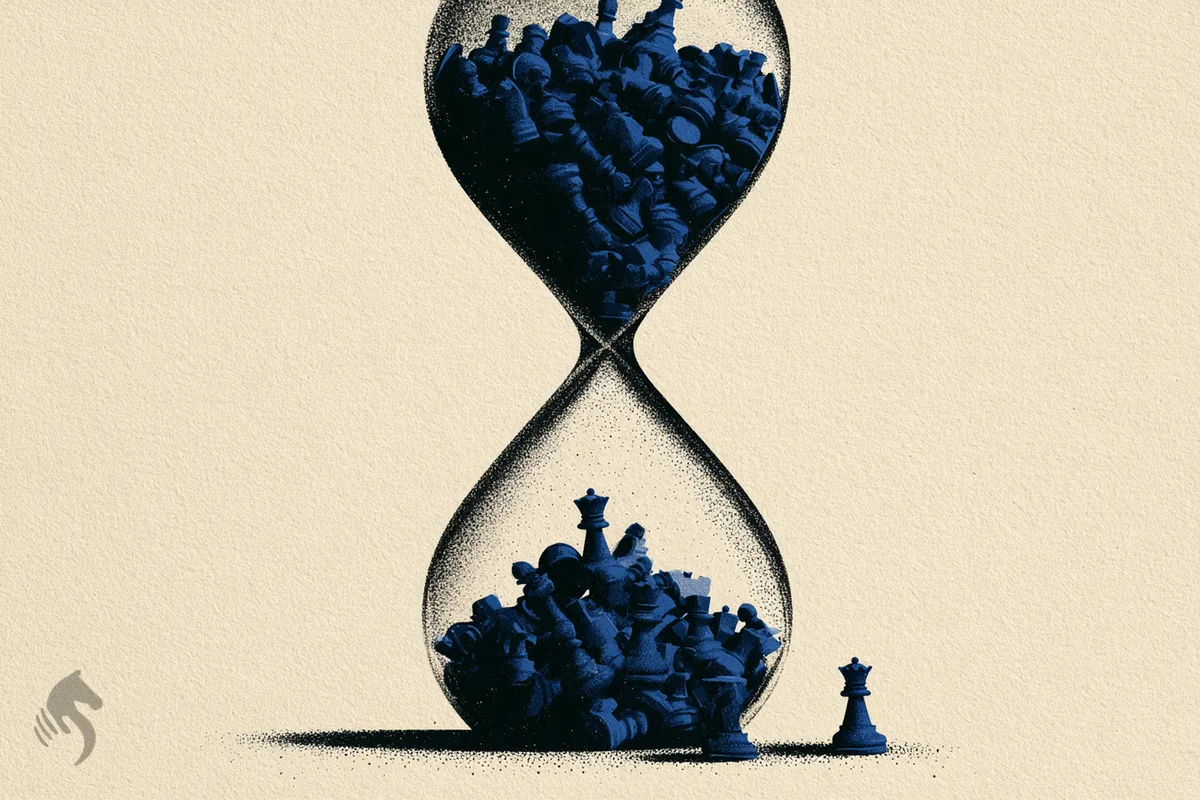
Chess is often described as the game of pure logic, a domain governed by rigor and predictability. And yet, anyone who has played a tactically tense game knows something else operates. One too many moves, a misplaced piece, and the entire structure collapses. What you feel in these moments is chaos in the technical sense.
What Is Chaos Theory?
Chaos theory is a branch of mathematics and physics that studies dynamic systems whose behavior is extremely sensitive to initial conditions. It was popularized by Edward Lorenz in the 1960s when he discovered, while modeling weather systems, that an infinitesimal variation in initial conditions produced radically different trajectories long-term.
The butterfly effect illustrates this property: a butterfly flapping wings in Brazil can, in theory, trigger a tornado in Texas weeks later.
Chaotic systems are deterministic: they follow precise laws, without randomness. But they are unpredictable long-term: error accumulation in calculating initial conditions grows exponentially.
Are Chess Chaotic?
Chess is a discrete finite system: the number of legal positions is immense but finite. Strictly speaking, the mathematical definition of chaos applies to continuous systems. But the analogy is structurally relevant.
Sensitivity to Initial Conditions
In a complex chess position, a single half-square difference in piece position can transform a winning position into a losing one. A pawn on f4 rather than f3 radically changes castling attack dynamics.
Modern analysis engines quantify this sensitivity. A position evaluated at +0.3 (slightly favorable to White) can, after three "inaccurate" but not catastrophic moves, swing to -1.5 (clearly favorable to Black).
Bifurcation Points
In chaos theory, a bifurcation point is a moment when a system's qualitative behavior changes according to a parameter's value. In chess, bifurcation points correspond to critical moves where the position's nature changes qualitatively.
In a castling attack, there's often a precise move after which the attack becomes irresistible. Before this move, both sides have resources. After this move, the causal chain becomes deterministic.
The Lyapunov Exponent: Measuring Chaos
The formal mathematical criterion of chaos is the Lyapunov exponent, noted λ. It quantifies the speed at which two initially very close trajectories diverge.
In chess, you can transpose the idea without rigor: take a position and its "neighbor" differing by half a square. Play the best moves in each and compare evaluation at depth 10, 15, 20. In a calm position, both trajectories stay close. In a tense position, the gap widens with every move.
The Dynamics of Tactical Positions
Tactically tense chess positions have a particularly chaotic dynamic. Consider a position with mutual sacrifices, advanced pawns, and active pieces on both sides. In these positions, the calculation tree explodes quickly, and a calculation error at depth 3 can invalidate an entire variation.
The Calculation Horizon
A phenomenon directly linked to chaos is the horizon effect in chess computer science. An engine searching to depth 10 can produce an erroneous evaluation if a decisive event occurs at move 11.
The Strange Attractor and Style of Play
By analogy, a Grandmaster's playing style can be thought of as an attractor in position space. Each player has a positional "comfort zone."
Anatoly Karpov naturally gravitated toward slightly advantageous but solid positions. Mikhail Tal gravitated toward chaotic and tactically explosive positions where the opponent could easily err under pressure.
Case Study: Kasparov–Topalov, Wijk aan Zee 1999
The game between Garry Kasparov and Veselin Topalov at Wijk aan Zee in 1999, often called "the Modern Immortal," is the most cited illustration of controlled chaos. At move 24, Kasparov sacrifices his Rook with Rxd4, launching a 15+ move combination almost entirely forced where the Black King traverses half the board under fire.
What makes the game chaotic in the technical sense: at every move of the combination, the evaluation gap between the correct line and the most tempting deviation exceeds +3.5. It's the archetype of a very high λ: the winning trajectory is unique, narrow, and bordered by precipices.
"Chaotic" Positions as Strategy
Understanding chaos theory has direct strategic application. Against a stronger opponent, the optimal strategy isn't always to play "the best move" in balanced positions. It's often to create chaotic positions where the stronger player's technical advantage is partially neutralized by complexity.
Complicated Isn't Chaotic
Distinguishing the two is crucial. A complicated position has many candidate moves but small evaluation gaps between them. A chaotic position has few viable candidates but enormous gaps.
For Your Game: Exploit or Avoid Chaos
Some practical rules:
- If you're weaker than the opponent and the position is calm, look for a move that increases the number of active pieces in contact, not one that simplifies.
- If you're stronger and have a technical advantage, the right reflex is the opposite: exchange pieces that produce chaos.
- In zeitnot, be lucid about where you are on the chaos map.
What Chaos Tells You About Beauty in Chess
The most beautiful games in chess history are often chaotic games. Tal's audacious sacrifices, Morphy's lightning attacks, Kasparov's irresistible complications, all this beauty is born from positions where chaos reigns and where a player has navigated with extraordinary precision where the opponent was lost.
Beauty in chess is perhaps the beauty of mastered chaos.
Sources
- Lorenz, E. N. (1963). Deterministic nonperiodic flow. Journal of Atmospheric Sciences, 20(2), 130-141.
- Regan, K. W., & Haworth, G. (2011). Intrinsic chess ratings. AAAI Workshop on Computers and Games.
- Gleick, J. (1987). Chaos: Making a New Science. Viking Press.
- Mandelbrot, B. (1982). The Fractal Geometry of Nature. W.H. Freeman.
Key Takeaways
- Complex chess positions exhibit sensitivity to initial conditions characteristic of chaotic systems (high Lyapunov exponent)
- Bifurcation points correspond to moments where the position's nature changes radically
- Chaos isn't disorder: it's deterministic complexity unpredictable long-term
- Complicated ≠ chaotic: it's the evaluation gap per move, not the number of candidates, that measures real risk
- Understanding where critical points of a position are is the key to advanced positional evaluation
Comments